Your Body Already Knows What You Think
- Dustin Rimmey
- Jun 17
- 7 min read

I want you to try something.
Think about a topic you have a strong opinion about. Something you feel clearly and specifically. Not something abstract, something real. A policy, a decision, a choice someone you know made, a position your school or district has taken that you either love or deeply disagree with.
Now: stand up and walk to one side of the room.
Not because the room means anything. Just because you committed to a direction. You chose a side. And I would be willing to bet that something small happened when you did: a slight straightening of the spine, maybe, or a feeling of mild readiness, or the particular alertness that comes from having declared yourself publicly, even to an empty room.
That is not a trivial thing. That is your body participating in your thinking.

We treat thinking as something that happens from the neck up; a purely cognitive process, invisible and internal, happening somewhere behind the eyes and accessible only through the words we eventually produce. But the research on embodied cognition has been quietly insisting for decades that this is wrong. That thinking is not just mental. That what we do with our bodies: where we stand, who we face, whether we move or stay still, shapes the quality and the nature of the ideas we produce.
We'll expand our visible thinking umbrella beyond just Project Zero for today to two different strategies. Both of them built around a radical premise: that how students position themselves physically and temporally in a discussion changes what they think, not just how they express it.
Philosophical Chairs

This one has deep roots in the debate and discussion world, and Philosophical Chairs does something that formal debate almost never does.
It lets you change your mind in public. And it makes that visible.
Here is how the activity works. The teacher presents a statement: a single, clear, arguable claim. Not a question. A statement. "Technology has made us less connected." "The ends justify the means." "This character made the right choice." Something that has a genuine agree side and a genuine disagree side, and where reasonable people could land on either one. Students decide their initial position and physically move to the side of the room that represents it, agree on one side, disagree on the other, with an undecided middle available for those who genuinely aren't sure.
Then the discussion begins.
Students argue their position. They respond to each other. They listen, and this is the part that makes Philosophical Chairs different from debates, they listen not to rebut but to genuinely consider. And when a student hears an argument that moves them, when a piece of reasoning lands in a way that shifts their thinking, they do something that no essay or worksheet can replicate.
They get up and walk across the room.
The physical movement is the thinking made visible. It is not metaphorical. When a student crosses the floor, they are making a public declaration: something I heard changed my mind. That is an act of intellectual courage. And it is one that most students have almost never been explicitly invited to make in an academic setting, because most academic settings reward consistency of position rather than flexibility of thinking.
Philosophical Chairs was developed as part of the AVID (Advancement Via Individual Determination) program and has been widely used across content areas and grade levels as a discussion and critical thinking strategy. The basic structure asks students to consider a statement, decide their position, discuss for ten to fifteen minutes, and then write a reflection that includes the comment that most challenged their thinking, whether they changed their mind, and how open-minded they were at the start of the conversation. That final reflection is not an add-on — it is where the metacognitive work happens. It asks students to narrate their own intellectual journey, which is a completely different and significantly harder task than summarizing the discussion.
A few things that make Philosophical Chairs work in practice. First, the statement matters enormously. It has to be genuinely arguable, not so loaded that everyone agrees, not so abstract that no one cares. The best statements are specific enough to feel real and open enough to generate genuine disagreement. Second, the undecided middle is not a cop-out; it is a legitimate intellectual position, and students who occupy it should be asked to articulate what evidence or argument would move them. Third, discussion norms are essential. Philosophical Chairs only works in a classroom where disagreement is safe, where "I changed my mind" is treated as a sign of strength rather than weakness.
That last condition is the one that most requires deliberate cultivation. Students who are moved by compelling evidence should be encouraged to switch sides, and managing dominant voices matters for keeping the activity productive. The teacher's role is not to argue but to facilitate — to make sure every side of the room gets heard, to ask follow-up questions that push thinking deeper, and to model the intellectual humility that the activity is designed to develop.

How I use it: Philosophical Chairs is my go-to for any text or topic where genuine controversy lives: ethical dilemmas in science, historical decisions with multiple defensible positions, literary characters whose choices you can argue either way, and current events where students have real stakes. I run it after students have had time to read and think, not cold. The discussion is richer when everyone arrives with something to defend. The debrief question I always end with: "What is the strongest argument from the side you disagreed with?" That question is the one that tells me whether genuine perspective-taking happened or whether students just performed it.
Sometimes I think adding paper to this before or after might clunk it up a little bit. However, if your students are engaging in their first Philosophical Chairs activity, then the template below could help both make their initial thinking and their evolution of their thinking more visible.
Save the Last Word for Me
If Philosophical Chairs is about what happens when you move your body across a room, Save the Last Word for Me is about what happens when you make yourself wait.
The strategy, developed by literacy researchers Kylene Beers and Bob Probst and popularized through the work of Short, Harste & Burke, works like this. Students read a text, any text, and identify two or three passages, sentences, or quotations that particularly strike them. They write each one on the front of an index card (or the template for their first couple of times through the protocol). On the back, they write their response: why they chose it, what it means to them, and what it made them think.
Then they get into small groups of three or four. One student shares their chosen passage, reads it aloud, and shows where it lives in the text. And then they go silent.
Not because they have nothing to say. Because the protocol requires it, the other members of the group respond first: what do they think it means? Why do they think this student chose it? What does it raise for them? They discuss the passage entirely without the presenter's interpretation in the room. And then, only then, after everyone else has had their say, the presenter gets the last word. They reveal why they chose it. They respond to what they heard. They have the conversation they've been waiting to have.
The silence is the strategy.

Here is what the wait does. When the presenter has to sit with their chosen passage while others interpret it, two things happen simultaneously. First, they listen differently than they would if they had already spoken; they are genuinely curious about what others see in something they chose, and that curiosity produces better listening than almost any instruction to "be a good listener" ever has. Second, they often discover that their interpretation is not the only defensible one, and sometimes not even the most interesting one. The wait creates the conditions for genuine surprise. And genuine surprise is one of the most reliable signs that real thinking is happening.
Research comparing Save the Last Word for Me to standard discussion formats found that students using this protocol engaged in more shared cognition and took greater ownership of the discussion, with students remarking that they enjoyed seeing how each student made different connections to the same text. That finding makes sense when you experience the protocol: because no one knows why the presenter chose their passage until the very end, everyone is genuinely invested in figuring it out. The mystery creates the engagement.
The strategy works equally well with images, too, giving students a collection of photographs, paintings, or posters and asking them to select ones that stand out, then explaining their choices after others have responded. That visual variation is particularly useful in content areas where text is not the primary medium, and it pairs beautifully with the visual thinking routines we covered earlier in this series.
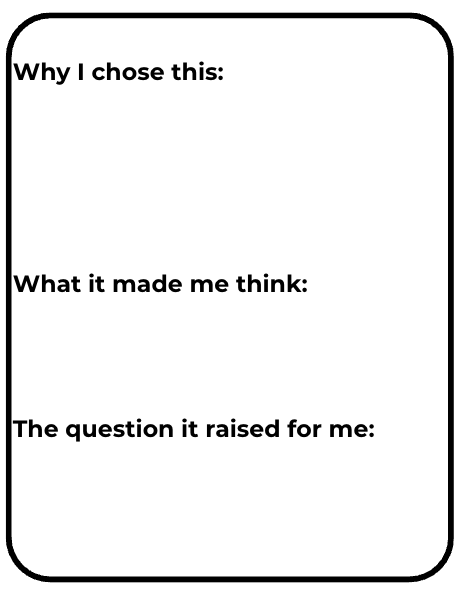
How I use it: Save the Last Word for Me is my go-to for any complex text where I want every student to arrive with something specific to contribute, which, as we discussed in Post Eight with Word, Phrase, Sentence, is one of the most reliable ways to ensure that nobody comes to a discussion empty-handed. The index card format is important: writing the passage on the front and the response on the back means students have to commit to their interpretation privately before the group discussion begins. That commitment changes the quality of the listening that follows. I also love this one for professional development with teachers — it works just as powerfully with adults as it does with students, and a room full of teachers experiencing it is usually a room full of teachers who want to use it Monday morning.
Grab the template here
The Power of the Pair
Philosophical Chairs. Save the Last Word for Me.
One asks students to make their thinking physical, to declare a position with their body and move across a room when something changes it. The other asks students to make their thinking temporal, to hold their interpretation in reserve while others speak, and discover what the waiting teaches them.
Neither of these is primarily a content strategy. They are both, at their core, strategies for developing the disposition that every thinking routine in this series has been quietly building toward: the willingness to be changed by what you encounter.
A student who can walk across a room when their mind changes is practicing intellectual humility made visible. A student who can sit silently while others interpret something they chose, and genuinely listen to what they hear, is practicing the patience that real listening requires. Both of those are harder than they sound. Both of them are worth practicing deliberately and repeatedly until they become habit.
Your body already knows what you think. These routines just make sure the rest of the classroom knows when it changes.
Free templates for all thinking routines in this post are linked above and in the free resource library.
Catching up on the series? [Part One] | [Part Two] | [Part Three] | [Part Four] | [Part Five]| [Part Six]/[Part Seven]/[Part Eight]/[Part Nine]


Comments