We are eight posts into this series! What a wild ride it has been!
Eight posts, somewhere north of twenty thinking routines. A Costco parking lot, a Tonic deep cut, This Old House, a soup can, and one very passionate argument about the Oxford comma. We have covered routines that teach students to observe carefully, argue honestly, find their words, push past their first thought, sit in complexity, see before they interpret, and document how far their thinking has traveled.
And across all of it, I have been assuming something that I want to name directly for the first time.
I have been assuming that the routines reach everyone.
They don’t. Not automatically. Not without intention.
Here is the uncomfortable truth about classroom discussion that every teacher knows: in most classrooms, most of the time, the same students talk. Not because the other students don’t have thoughts. Not because the quiet ones don’t have questions or ideas or genuinely interesting takes on the thing you just read together. But because discussion; the traditional raise-your-hand, wait-to-be-called-on, perform-your-thinking-out-loud kind of discussion, is a format that systematically advantages certain students and systematically disadvantages others.
The fast thinkers. The verbally confident. The students who have been told their whole lives that what they have to say is worth saying.
The students who process more slowly, who need time before they’re ready to speak, who have been talked over enough times that they’ve stopped trying (me), they have thoughts too. They are thinking. They are doing all the things we’ve asked them to do across seven posts of thinking routines. They just can’t get it out in the thirty seconds between the question and the first hand that shoots up.
Post Eight. Two routines. Both of them are designed to address exactly this.
Chalk Talk
Imagine this:
You walk into a classroom, and there is a large piece of paper on every table, or a prompt written on the whiteboard, or a question posted at stations around the room. Students pick up a marker. And then…nobody speaks. Not a word. Not a whisper. Not a “wait, what are we doing?” The entire discussion happens in writing, on the shared paper (or digital space), in real time, with everyone able to see and respond to everyone else’s thinking.
That is Chalk Talk. And it is one of the most quietly radical things you can do in a classroom.
The routine, developed as part of Cultures of Thinking at Project Zero and adapted from Hilton Smith of the Foxfire Fund, works like this: a question or prompt is written at the center of a large shared surface. Students respond in writing to the prompt and to each other’s responses. They can ask questions about what someone else wrote. They can draw connections between ideas. They can push back, elaborate, agree, and extend. All of it happens silently, on the page, with markers in hand.
The silence is not incidental. The silence is the whole point.
Here is what the silence does: it removes the social performance of discussion. It removes the pressure to speak before you’re ready. It removes the dynamic where the fastest, loudest, most verbally confident voice fills the space before anyone else has had time to think. In a Chalk Talk, the student who processes slowly has exactly as much time as the student who processes quickly, because nobody is talking over them. The student who has been told their ideas aren’t worth sharing can write something down and watch someone else circle it and add to it, which is a completely different experience than raising a hand and being ignored.
Project Zero notes something important: there’s a degree of anonymity in Chalk Talk. Students sign their comments, but the writing is visible rather than spoken, which frees up some learners to take more risks and offer ideas they might not voice aloud. That’s not a small thing. That is the difference between a student feeling like they belong in a discussion and feeling like the discussion is for other people.
The debrief matters too. After the silent conversation, you bring the room back together, vocally this time, and ask: What themes emerged? What surprised you? What questions do you want to follow up on? The silent writing generates the material; the spoken debrief unpacks it. Both halves are essential.
How I use it: Chalk Talk is extraordinary for complex, conceptual, or controversial questions — the kind that benefit from people seeing multiple perspectives before they commit to one. I love it as a mid-unit check-in, as a way to process a difficult text or discussion, and as an entry event that surfaces what students are already thinking before I’ve said a single word about a new topic. It also works beautifully for professional development with teachers. If you’ve ever been in a PD session where three people dominated the conversation and thirty others sat quietly, you know exactly why.
One note on format before you grab the template: Chalk Talk is one of those routines that works beautifully in multiple environments, and the right choice depends on your classroom. The traditional version — big paper, markers, students physically moving around the room — has a magic to it that’s hard to replicate digitally. There’s something about seeing handwriting pile up on a shared page, watching a student walk over and circle someone else’s idea, that makes the thinking feel genuinely collaborative in a way that a screen sometimes can’t.
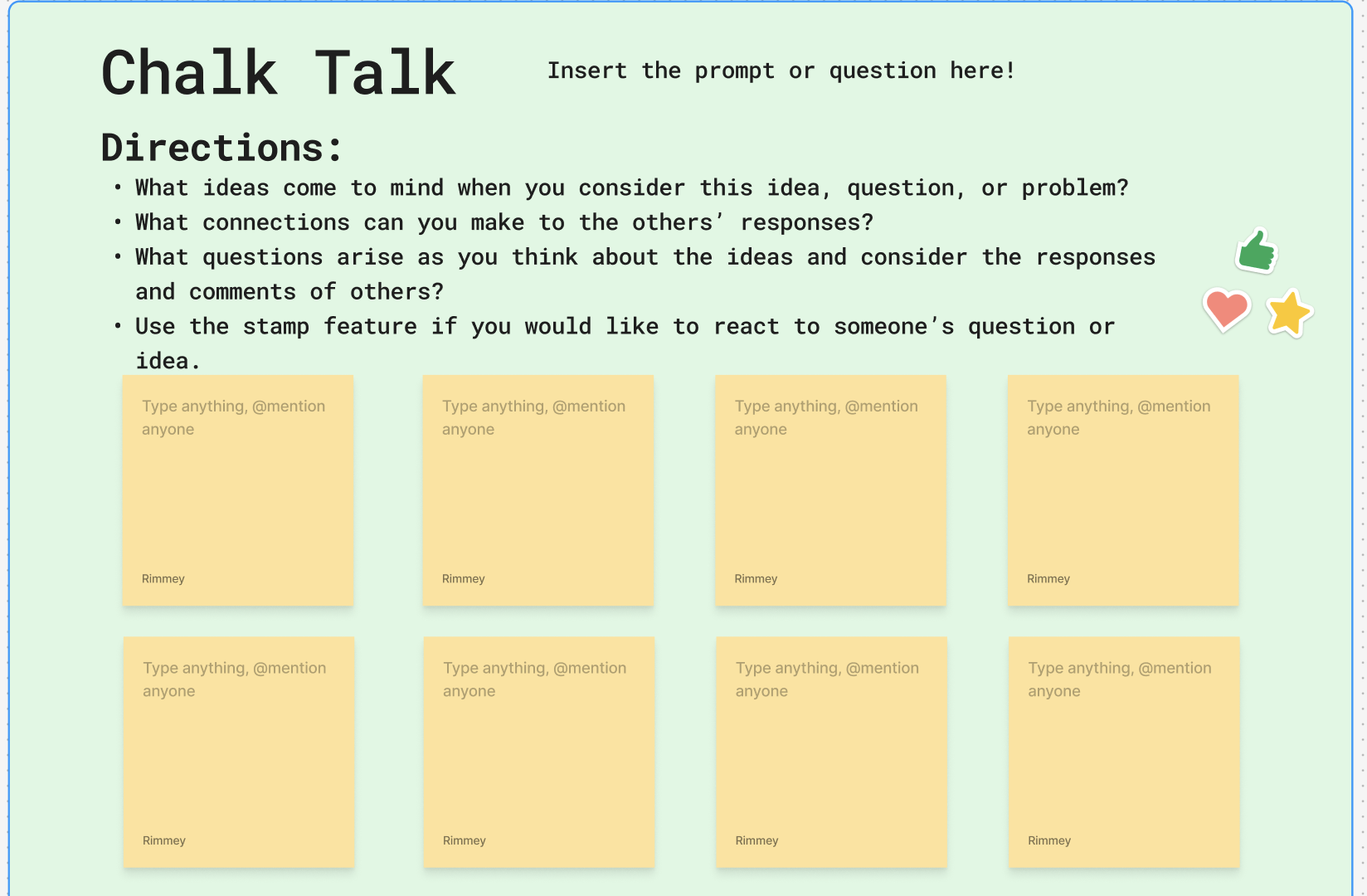
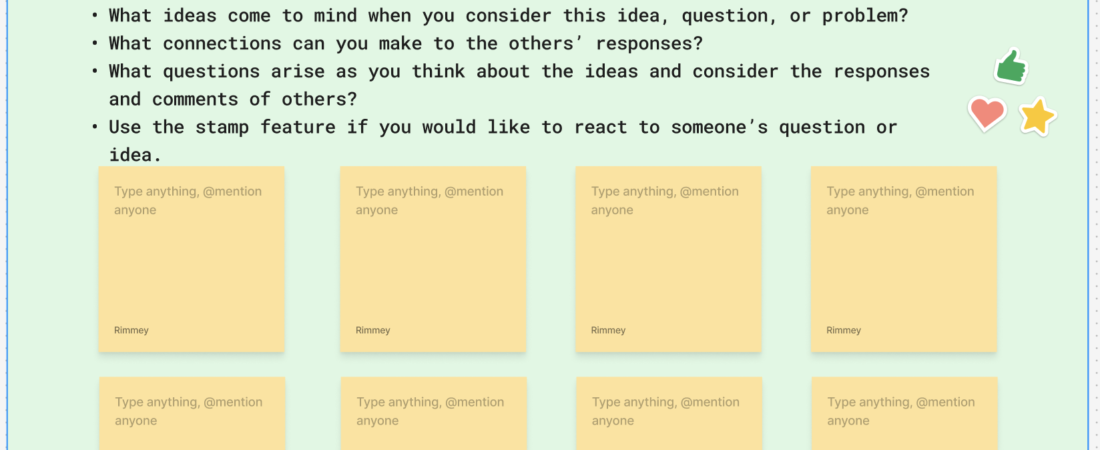
That said, I’ve built an interactive Chalk Talk discussion template in Figma that works beautifully for hybrid classrooms, 1:1 device environments, or any context where physical paper isn’t practical. Students can type their responses, draw connections with arrows, and see each other’s thinking in real time on a shared canvas; same silent conversation, different surface.
My honest recommendation: if you can do it on paper, do it on paper. If your classroom lives on devices, the Figma template gets you there. And if you want the best of both worlds, run it as a station rotation: some stations on paper, some on the shared Figma board, and watch what happens when students move between them.
Grab the template!
2. Word, Phrase, Sentence
If Chalk Talk changes who gets to participate in a discussion, Word, Phrase, Sentence changes what they bring to it.
Here is the problem with most text-based discussions: students arrive empty-handed. They read something, or they were supposed to read something, and then they’re asked to discuss it, and most of them have nothing specific to hold onto. They remember the general vibe. They remember whether they liked it. They do not remember the specific sentence that made them sit up straighter, or the single word that didn’t quite land right, or the phrase that they read three times because something in it felt important.
Word, Phrase, Sentence fixes this. The routine is exactly what it sounds like. After reading a text, students identify:
A word that captured their attention — that struck them as powerful, surprising, or worth sitting with.
A phrase that moved, engaged, or provoked them in some way.
A sentence that felt meaningful — one that they believe captures something core about the text.
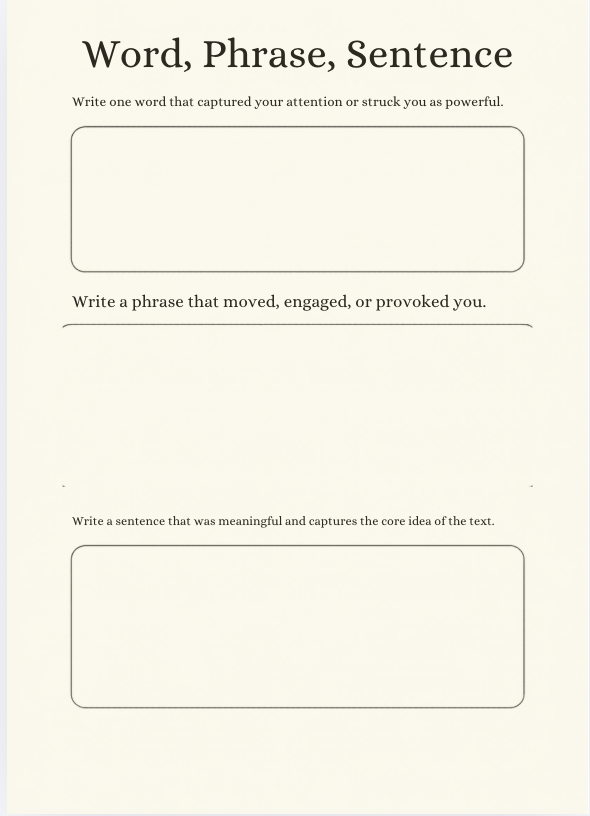
Then they share those selections with a group, explain why they chose them, and listen as others share theirs. The magic is in the discussion that follows: why did different people pull different things? What does it mean that twelve people read the same paragraph and walked away with twelve different sentences? What themes emerge when you look at everyone’s words together?
Project Zero is clear on where the power lives in this routine: not in the selections themselves, but in the explanation of why. The word or phrase or sentence a student chooses is interesting. The reason they chose it is the thinking. “I chose this word because it felt contradictory to everything the author had argued in the previous two paragraphs,” is a student doing literary analysis. They just don’t know that’s what it’s called yet, because you haven’t told them, you just asked them to pick a word.
This routine also does something deeply practical for teachers: it gives every student something specific to say before the discussion begins. Nobody is empty-handed. Nobody has to generate an observation from scratch in front of their peers. They already did the work: they picked their word, their phrase, their sentence — and now they get to defend it. That’s a completely different starting position than “does anyone have thoughts about this chapter?”
Note that Project Zero actually names this one Word, Phrase, Sentence: word first, then phrase, then sentence, though some teachers flip the order and run it sentence-down to paragraph-down to word, which also works. The important thing is not the order. The important thing is that students are doing the distillation: finding the essential thing inside a complex thing, before they’re asked to discuss it.
How I use it: Word, Phrase, Sentence is my go-to for any text-based discussion: primary sources, scientific studies, news articles, speech transcripts, song lyrics, anything. I run it individually first, in writing, before any sharing happens; students need to make their choices without being influenced by what others pick. Then small groups, then whole class. I also love pairing it with Chalk Talk: students do Word, Phrase, Sentence individually to arrive with something in hand, then bring those selections into a Chalk Talk where they can see everyone else’s choices on the shared paper at once. That combination is one of the most efficient ways I know to make a whole room’s thinking visible simultaneously.
Grab the template!
The Thread Running Through Both
Every routine in this series has been trying to make thinking visible. But these two are trying to do something slightly more specific: they’re trying to make everyone’s thinking visible. Not just the students who are already comfortable performing their ideas out loud. Not just the fastest processors or the most verbally confident. Everyone.
Chalk Talk does it by removing the pressure to speak before you’re ready. Word, Phrase, Sentence does it by making sure nobody arrives to the conversation empty-handed.
Together they are a structural argument for a different kind of classroom — one where the quantity of participation is less important than the quality of it, and where quality is available to every student in the room, not just the ones who already believed their thinking was worth sharing.
Because here is what seven posts of thinking routines have taught me about teaching:
The thinking is already there. In every quiet student, in every student who has been talked over, in every student who stopped raising their hand somewhere around third grade and decided that discussion was for other people, the thinking is there.
These routines just make it impossible to keep quiet.
Templates for all routines in this post are linked above and in the free resource library.
Catching up on the series? [Part One] | [Part Two] | [Part Three] | [Part Four] | [Part Five]| [Part Six]/[Part Seven]