I’ve always been fond of a good ‘ol home renovation show. It’s something that actually is deeply rooted in my childhood. Long before the days of brothers who had property or uppers that needed to be fixed, there was one show I would watch on the regular with my dad. This. Old. House.
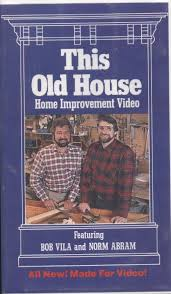
Not only would I watch our local PBS station to see what Bob, Norm, Richard, Tom, and Roger were up to, but my dad also collected the books, the plans, the suggested gear. Unlike the modern home reno show, which shows you start to finish in a nice and neat hour on HGTV, This Old House would take a WHOLE SEASON to show you the transformation of the entire property. Regardless of how long you waited to see the final polished result, the reveal still hits the same.
There is something deeply satisfying about seeing where something started and where it ended up. The distance between those two points is the story. And the story only works because you saw the before. If the show just showed you the finished kitchen, you’d think “nice kitchen.” But when you’ve seen the linoleum and the drop ceiling and the cabinet doors that don’t quite close, the reveal means something. The change means something (god, if any of this housing vocabulary translated to actual handy skill, I would be more confident to wield a hammer).
I think about this constantly in the context of learning.
Learning is change. Not the accumulation of facts, the actual shifting of what you think and how you see things. We show students the finished kitchen. We test them on the finished kitchen. We grade them on the finished kitchen. But we rarely document the linoleum.
This is Post Seven in the Project Zero Thinking Routines series. And these two routines are, together, one of the most complete learning arcs in the entire toolbox: because one of them documents the linoleum, and the other documents the reveal.
1. Think, Puzzle, Explore
Each season of This Old House begins in a very similar fashion to most units of study in our classrooms. Here are the similarities in workflow:
The teacher introduces the topic (the producers have already selected the home for the season). The teacher provides information (the hosts tell us what is happening on every single episode). The students receive the information (we try not to destroy our homes in the spirit of renovation). The students are assessed on the information (we talk about the final result with our friends, family, whoever still knows that This Old House is still recorded and televised in the year of our lord 2026).
The difference between This Old House and the classroom is easy. We chose to watch TOH, so we forfeit our agency to the decisions made by producers. When introducing our unit’s blueprints to our classrooms, however, nobody asked what the students already thought. Nobody surfaced what they were curious about. Nobody identified the questions worth pursuing before the unit told them which ones to explore.
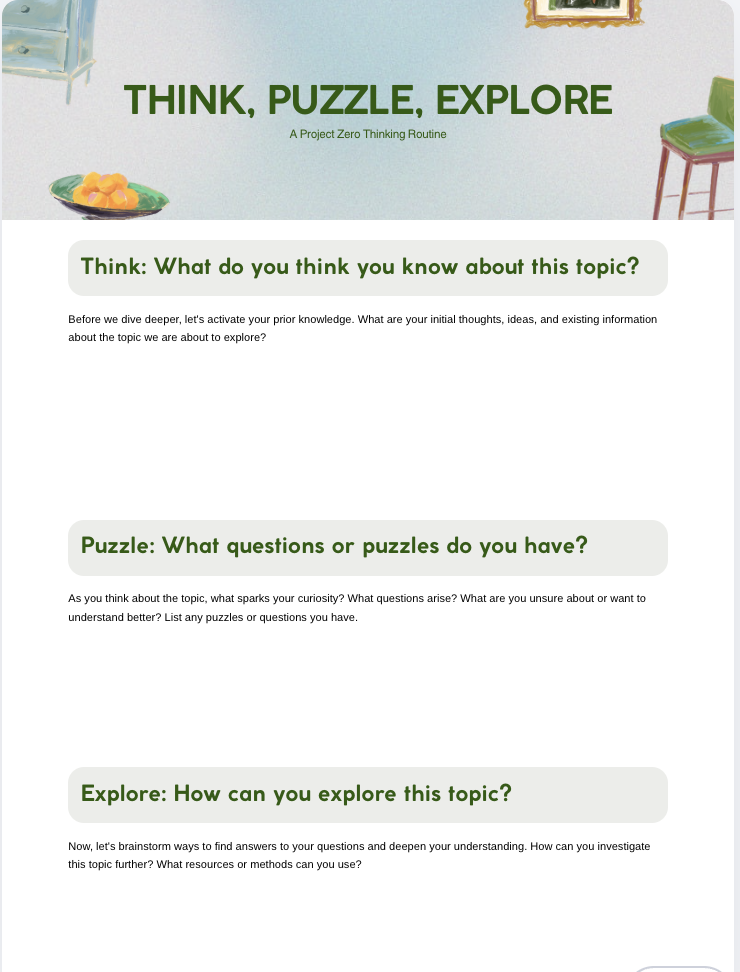
Think, Puzzle, Explore is Project Zero’s answer. It is, in my opinion, one of the most elegantly designed entry routines in the whole library. Three prompts, used at the beginning of a new topic, concept, or theme:
What do you think you know about this topic?
What questions or puzzles do you have?
How might you explore this?
The first step — Think — activates prior knowledge. Students write down everything they already think they know about the topic, in whatever form it takes. Certainties, half-memories, hunches, things they’re pretty sure they learned once and may or may not have retained correctly. All of it comes out.
The second step — Puzzle — is where it gets interesting. Students identify the questions they genuinely have. Not the questions the teacher wants them to have. Not the questions the unit will answer. The ones they’re actually puzzling over. The ones that feel unresolved or mysterious or just plain interesting.
The third step — Explore — asks students to think about how they might pursue those questions. What sources would they go to? What would they look at, read, or investigate? This is the step that Project Zero notes is particularly useful for independent inquiry — it asks students to think like researchers before they’ve been handed the research.
Here’s why this routine is more powerful than it looks: the Think step is not just activating prior knowledge for the students. It is surfacing prior knowledge for you. When thirty students write down what they think they know about the Civil War, or climate change, or photosynthesis, or the quadratic formula, you learn something invaluable about where your class actually is before you begin. The misconceptions surface immediately. The gaps become visible. And the questions in the Puzzle step, those are the questions worth teaching toward. Project Zero is clear on this: returning to those questions over the course of the unit, and at the end, lets students see how their thinking has developed. Which is exactly where Routine Two comes in.
How I use it: Think, Puzzle, Explore is my go-to unit launch for any conceptual or informational topic. I run it individually and in writing first, then open it to discussion: the Puzzle step almost always generates better driving questions than anything I could have written in a lesson plan. I also use it as a pre-assessment that doesn’t feel like a pre-assessment, because students experience it as curiosity-building rather than knowledge-testing.
Grab the template!
2. I Used to Think… Now I Think…
When I was in high school, I was absolutely certain of several things.
That the band I loved most was the greatest band in human history (Less Than Jake baby!) and anyone who disagreed was simply wrong. That the subject I was worst at was inherently pointless and would never be relevant to my life (Geometry and Chemistry II enter the chat). That I had a pretty good handle on how the world worked and how people in it behaved.
I was wrong about most of these things (LESS THAN JAKE FOR LIFE BABY!). Not a little wrong. Significantly, sometimes embarrassingly, wrong.
And here is what I wish someone had asked me at seventeen: how did your thinking change, and why?
Not because the answer would have been impressive. Because the act of answering it, of having to articulate the distance between what I used to believe and what I now believe, and trace the path between them, would have taught me something about how learning actually works. About the fact that changing your mind is not a failure. It is the whole point.
I Used to Think… Now I Think… is one of the most deceptively simple routines in the Project Zero library. Two sentence stems. That’s the whole thing.
I used to think…
Now I think…
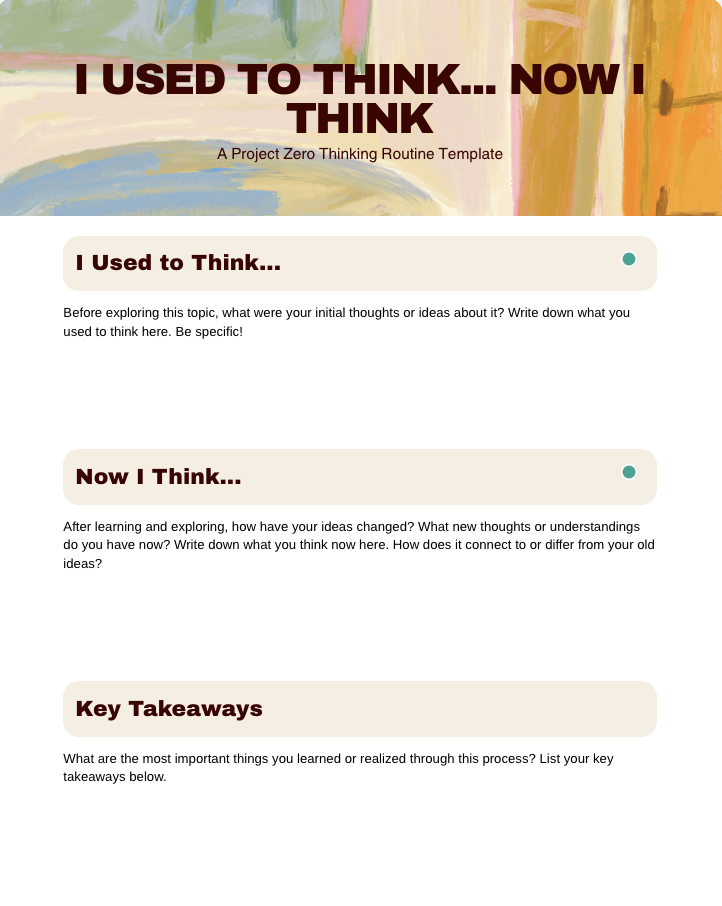
Students complete both stems about whatever topic or concept they’ve been studying: after a unit, after a discussion, after a significant learning experience, after anything that was supposed to change how they see something. And then, they explain why their thinking changed. What happened? What did they encounter? What shifted?
Project Zero is explicit about this: the explanation of the change is where the reasoning lives. It’s not enough to say “I used to think X and now I think Y.” The learning is in the because. The learning is in the “I changed my mind when I read about…” or “I used to think that until I realized that…” or “What shifted my thinking was…”
That explanation is a student showing you their work. Not the answer to the problem, the thinking that got them there (remember all of my thoughts on AI-resistant assignments?).
This routine also does something quietly radical: it treats changing your mind as an achievement rather than a weakness. In most academic contexts, uncertainty is something to hide. Students perform confidence because confidence is what gets rewarded. I Used to Think/Now I Think makes intellectual humility visible and valued. It tells students that the fact that you changed your thinking is not a sign that you were wrong before. It’s a sign that you learned something.
Project Zero notes that when you first introduce this routine, it helps to run it as a whole group: model the process, probe students’ thinking publicly, and show them what a genuine and specific explanation of changed thinking looks like. Once students understand that they’re not being asked to confess ignorance but to demonstrate growth, they lean into it. Every time.
How I use it: End of unit, end of a major discussion, after any experience that was designed to shift perspective. I also love running Think, Puzzle, Explore at the beginning of a unit, and I Used to Think/Now I Think at the end — the pairing is extraordinary, because students can look back at their original Think responses and trace exactly how their thinking has traveled. The before and the after, right there on the page. The linoleum and the reveal.
Grab the template!
The Thread Running Through Both
Think, Puzzle, Explore. I Used to Think, Now I Think.
One captures where students are before learning begins: the prior knowledge, the real questions, the genuine curiosity. The other captures where they are after: the changed thinking, the traced reasoning, the honest reckoning with how far they’ve come.
Together, they make the learning visible in both directions. And visibility, as this entire series has argued from the very first post, is everything. You cannot build on thinking you can’t see. You cannot honor growth you never documented. You cannot understand a student’s mind if you only ever look at where they ended up and never at where they started.
The home renovation reveal only means something because you saw the before.
Document the linoleum. Run the reveal. Show them how far they’ve come.
Post Eight next Wednesday!
Templates for all routines in this post are linked above and in the free resource library.
Catching up on the series? [Part One] | [Part Two] | [Part Three] | [Part Four] | [Part Five]| [Part Six]