I want to tell you about the worst argument I have ever witnessed at a Thanksgiving dinner table.
It was not about politics. It was not about religion. It was about a parking spot.
My father, a man who is, in most other contexts, a perfectly reasonable human being, spent forty-five minutes constructing an airtight legal, moral, and philosophical case for why he had been wronged in a Costco parking lot three weeks prior. He had witnesses. He had a diagram. He had, I am not exaggerating, printed receipts.
The thing is… He wasn’t wrong. He had been wronged. The other driver was also, in several important ways, not wrong. The parking lot was confusing. The signage was bad. Both of them had legitimate claims. And my father, who could not tolerate the idea that a situation might not have a clean villain and a clean victim, spent forty-five minutes of his one life trying to resolve something that was fundamentally unresolvable.
I tend to think about that parking lot frequently when I think about what we’re actually teaching students when we teach them to think.
Because here is the truth: most of the things worth thinking about don’t resolve. The interesting ethical questions don’t have clean answers. The best pieces of art contain contradictions. The most important news stories are told through choices that both reveal and obscure. The world is full of Costco parking lots, situations where multiple things are true simultaneously, where fairness tugs in more than one direction, where beauty and manipulation live right next to each other and you have to decide what you’re looking at.
And most of our students have never been explicitly taught to sit in that.
Post Five. Two more Project Zero thinking routines. Both of them are designed to do exactly one thing: teach students that not everything resolves…and that this is not a failure of thinking. It is the beginning of wisdom.
Tug of War
Here’s what most classroom argument activities actually teach students, whether we mean them to or not:
Pick a side. Defend it. Win.
The goal, implicit in every debate format and persuasive essay rubric I have ever seen, is to build the strongest possible case for one position and defeat the other. We call this critical thinking. What it actually teaches, in many cases, is motivated reasoning: the practice of working backward from a conclusion you’ve already committed to and finding evidence to support it.
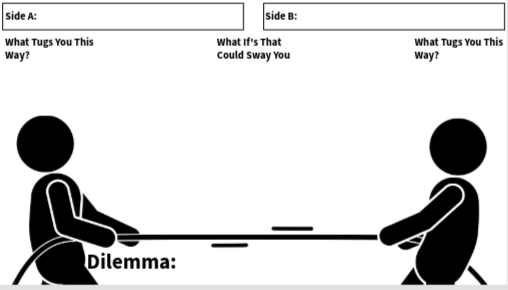
Tug of War is a direct intervention against this.
The routine is built around a fairness dilemma: a situation that looks like it has a right answer but actually has legitimate forces pulling in both directions. The visual metaphor is the whole game: students are looking at a rope, and they’re placing reasons on either side of it based on which direction those reasons pull. Not which side they personally agree with. Which direction the reason actually tugs.
Here’s how it works. The class is presented with a dilemma: testing medicine on animals, adding a player to a game that’s already started, removing a book from a library, a character in a novel choosing between two loyalties. Students generate reasons on both sides of the rope, writing each on a separate note. Then, and this is the move that makes the routine, they consider the strength of each reason. The strongest reasons go at the far ends of the rope. The weaker ones sit closer to the middle. The result is not a winner. It’s a map of the complexity.
The discussion that follows asks: What new ideas emerged? What changed in your thinking? How would you describe this dilemma to someone who thought it was simple?
That last question is the one I love most. Because the goal of Tug of War is not to resolve the dilemma. It is to make students genuinely understand why it is one.
This connects directly to everything I know about competitive debate, and I say this as someone who has spent most of their life in that world. The debaters who become genuinely good are not the ones who learn to win arguments. They’re the ones who learn to understand both sides so thoroughly that they can argue either one with equal conviction. Tug of War builds that muscle. It asks students to take the strength of the opposing pull seriously, not as a rhetorical exercise, but as an act of intellectual honesty.
My dad needed this routine. He really did.
How I use it: Tug of War is extraordinary for ethical dilemmas in science (should we edit human genes? is animal testing ever justified?), for historical decisions (was dropping the atomic bomb the right choice?), for literary analysis (was the character’s choice justified?), and for any current event where people are talking past each other because they’ve each only loaded one side of the rope. I’ve used it as both an individual written activity and a whole-class collaborative exercise — both work, but the collaborative version, where students have to negotiate where each reason goes on the rope, produces something genuinely special.
Beauty and Truth
I want you to look at a photograph for a moment.
You don’t have one in front of you, so I’ll describe it: it’s a single image from a war zone. A child. Dust on their face. Eyes open wide. In the background, something is burning. The light is extraordinary — golden hour, the kind of light that makes everything look significant. The composition is perfect. It is, by any technical standard, a beautiful photograph.
And it is about something horrifying.
Here is the question the Beauty and Truth routine asks students to sit with: How might beauty reveal truth and how might beauty conceal it?
That is not a comfortable question. It is also one of the most important questions anyone can learn to ask.
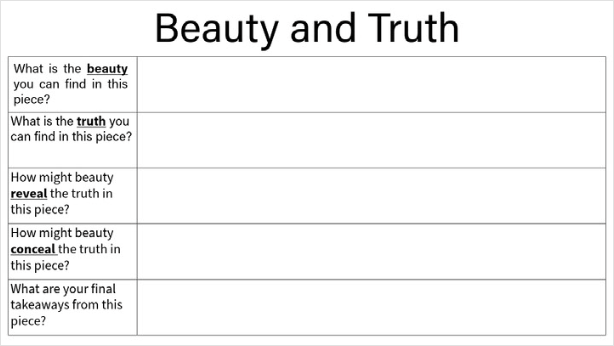
Beauty and Truth is a Project Zero routine built around exactly this tension. It works with any piece of content where aesthetics and information are entangled: news photography, documentary film, works of literature, paintings, data visualizations, and social media posts.
The four questions at the heart of the routine are deceptively simple:
Can you find beauty in this?
Can you find truth in this?
How might beauty reveal truth?
How might beauty conceal truth?
The first two questions are a warm-up. The last two are where the real work happens.
Because the truth is that beauty is not neutral. Every editorial choice a photographer makes, every word a journalist selects, every frame a filmmaker holds is both an act of revelation and an act of concealment. Something is always in the shot. Something is always out of it. The most beautiful images are often the most carefully constructed, and the construction shapes what we believe about the reality they claim to document.
We live in a world that is absolutely drowning in beautiful, carefully constructed images designed to make us feel things, believe things, and share things. Our students consume hundreds of them a day. And most of them have never once been asked to look at something beautiful and ask: ” What is this hiding?
This routine also does something gorgeous for literature and art. A poem about grief can be heartbreakingly beautiful, and that beauty can make it easier to feel the grief, to let it land, to understand it as something universal rather than private. Beauty reveals truth there. But a propaganda poster can also be beautiful: clean lines, bold colors, a stirring image, and that beauty is doing something different. It is making a lie easier to swallow.
The ability to hold both of those things simultaneously, beauty as revelation and beauty as concealment, is not just aesthetic literacy. It is survival literacy. It is the skill that separates a citizen who can think from a consumer who can be managed.
Project Zero notes something important about this routine: students often hold the misconception that photographs reveal truth simply by virtue of being photographs. The camera was there. It must be showing us what happened. Beauty and Truth is a structured intervention against exactly that assumption.
How I use it: Beauty and Truth is my go-to for news media literacy, for primary source photographs in history, and for any piece of literary or visual art where I want students to think about craft as a choice rather than a given.
I also love using it with data visualizations: a beautifully designed chart can make a misleading statistic look like a settled fact, and teaching students to ask “what might this be hiding?” about a graph is one of the most practically useful things you can do for their futures. I run the four questions as a written individual activity first, then open it to discussion: the gap between what students find beautiful and what they find truthful, and whether those things overlap, is always where the most interesting conversation lives.
What These Two Have in Common
Tug of War. Beauty and Truth.
On the surface, they look like very different routines. One is about fairness and moral complexity, and one is about aesthetics and critical media literacy. But they are doing the same fundamental thing.
They are both teaching students to resist the most powerful cognitive pull there is: the pull toward resolution.
The pull that says: pick a side. The pull that says: this is beautiful, therefore it is true. The pull that says: someone must be right and someone must be wrong and my job is to figure out which is which and be done with it.
Tug of War says: stay on the rope. Look at both sides. Feel the pull of each one. Don’t resolve it until you genuinely understand why it’s hard.
Beauty and Truth says: look at what moves you. Then ask what it might be hiding. Then look again.
Both of them are, at their core, asking students to do something that my father could not do in a Costco parking lot. To sit in the complexity long enough to actually understand it, rather than escaping into the comfort of a verdict.
That is not just a thinking skill. That is emotional maturity. That is intellectual courage. That is, I would argue, one of the most important things a classroom can practice.
Your students live in a world that is going to throw fairness dilemmas and beautiful lies at them every single day for the rest of their lives. Give them the rope. Teach them to look for what’s hidden.
Post Six is coming next Wednesday.
Templates for both routines are linked above. Catching up on the series? Start here: [Part One] | [Part Two] | [Part Three] | [Part Four].