
We’ve all been there. You just finished explaining a concept, laying out a brilliant plan, or sharing an exciting new idea. You pause, look out at your audience (whether that’s a classroom of students, your kids at the dinner table, or your team at work), and you get… blank stares.
It’s frustrating! We spend so much time focusing on the stuff we are sharing, but we rarely stop to think about the hidden gears turning—or completely stalled out—in the minds of the people listening.
Learning and problem-solving aren’t just about soaking up facts; they’re about the messy, active process of thinking. But here is the catch: thinking is invisible. So, how on earth do we bring it to the surface?
Enter a total game-changer: Harvard University’s Project Zero and the magic of Thinking Routines.
I’m not going to claim to be the person to discover, or remember Project Zero and all of their contributions to academia. However, I will say that I don’t hear them discussed all that often in the current educational zeitgeist. Last week, I started reading the new Designing EduProtocols by Mark Wallace (and Jon and Marlena adding their thoughts). These routines popped into my head as I was thinking of how I could craft my own EduProtocols to share with the “Jedi Council.” These simple visible thinking skills popped into my head as a starting point. Don’t worry, a review of the book is coming on Friday!
What in the World is Project Zero?
Back in 1967, the Harvard Graduate School of Education started Project Zero to figure out how to boost learning, thinking, and creativity. Over the years, their research has completely changed how educators and leaders view intelligence.
One of their best takeaways is the Visible Thinking framework. It operates on one brilliant, simple rule: If we want to build powerful thinkers, we have to make the actual process of thinking visible.
The Magic of “Thinking Routines”
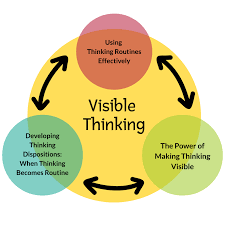
To do this, the researchers created what they call Thinking Routines.
A Thinking Routine is a simple, repeatable set of questions designed to guide your brain through processing information.
Forget complicated lesson plans or rigid worksheets. These routines are quick, flexible micro-strategies. The goal is to use them so often that they become natural “habits of mind.”
Skip the Prep Work: Grab the Templates!
Want to start using these right away without building everything from scratch? I’ve got you covered!
I’ve created ready-to-go templates for all six of these routines so you can plug and play them directly into your workflow. Head on over to the Templates page and pick the routine and platform that works the best for you! I’ve got them set up for Canva, Adobe Express, Google Slides, Kami, and Genially
Ready to try them out? Here are six of my absolute favorites that you can start using today.
1. See, Think, Wonder
Best for: Introducing a new topic, looking at an image, or sparking curiosity.
This is a fantastic way to slow people down before they jump to conclusions. It forces observation first, then interpretation.
See: What do you notice? (Stick strictly to the facts. Just the raw data!)
Think: What do you think is going on here? (Now, use those clues to make a guess.)
Wonder: What does this make you wonder? (Let the curiosity run wild and ask bigger questions.)
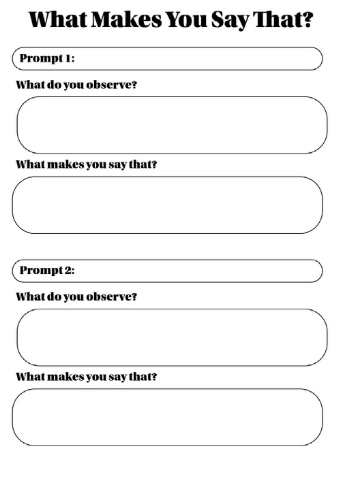
2. What Makes You Say That?
Best for: Backing up claims and building an evidence-based culture.
This is the ultimate “show your work” routine, but without sounding confrontational. It asks people to naturally link their opinions to evidence.
What’s going on? (State your observation or opinion).
What do you see that makes you say that? (Provide the evidence or reasoning).
Try it: Next time a coworker or a student makes a bold claim, just ask, “What makes you say that?” It instantly shifts the conversation from a debate to a discovery of how they arrived at their conclusion.
3. Connect, Extend, Challenge
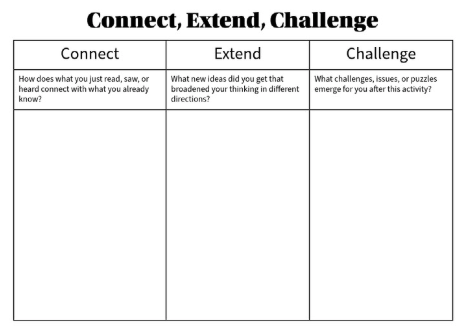
Best for: Processing a new article, video, book, or lecture.
When we learn something new, we have to hook it onto something we already know. This routine makes that process happen on purpose.
Connect: How does this new info connect to something you already knew?
Extend: How did this push your thinking in a new direction?
Challenge: What’s still confusing? What puzzles do you still need to solve?
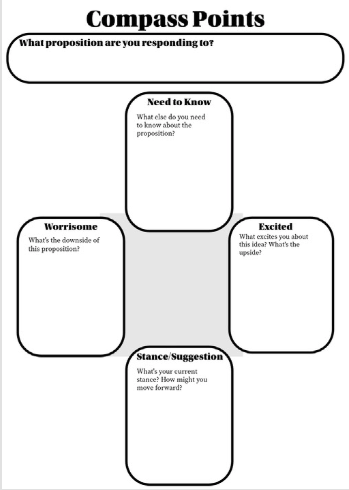
4. Compass Points
Best for: Evaluating a new proposal, idea, or upcoming change.
Using the points of a compass, this routine helps a group look at a new idea from all angles before making a decision. It’s a lifesaver for team meetings!
E – Excitements: What excites you about this idea? What’s the upside?
W – Worries: What do you find worrisome about this? What are the downsides?
N – Needs to Know: What else do you need to know or find out to understand this fully?
S – Stance or Steps: What is your current stance on the idea? What steps should we take next?
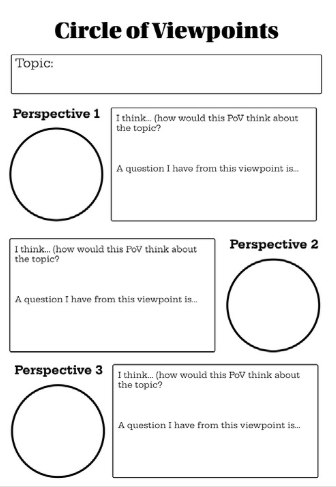
5. Circle of Viewpoints
Best for: Building empathy and exploring complex, controversial topics.
It’s easy to get stuck in our own heads. This routine forces us to step out of our own shoes and look at a situation from a completely different angle.
Identify: Brainstorm a list of different perspectives around a topic.
Adopt: Choose one of those viewpoints to step into.
Speak: “I am thinking about [the topic] from the point of view of [the chosen perspective]. I think…”Templates
Question: “A question I have from this viewpoint is…”
6. I Used to Think… Now I Think…
Best for: Wrapping up a project and celebrating “lightbulb” moments.
This routine is the ultimate way to show growth. It helps people realize that changing your mind when you get new information isn’t a sign of weakness—it’s proof that you’re learning!
I used to think… (Name the old misconception or limited idea).
Now I think… (Share the new, upgraded perspective)
The Bottom Line
We might not have x-ray vision to see thoughts forming in someone’s brain, but Project Zero’s thinking routines are the next best thing. By folding routines like What Makes You Say That? or Compass Points into our daily conversations, we aren’t just telling people what to think—we are giving them the tools for how to think. And that is pretty powerful.