
How many of us can relate to the following situation?
Last year, I was teaching a unit on the Civil Rights Movement, and we had just finished reading a primary source, a firsthand account from a Freedom Rider. Heavy stuff. Important stuff. The kind of stuff that you want students to genuinely sit with.
So I asked the class what they thought.
Silence.
Not the good kind of silence. Not the “I am processing something profound” silence. The “I have not been given a single tool to turn what I just felt into a sentence” silence.
And here is the part that’s haunting: they HAD thoughts. I could see it on their faces. Furrowed brows. One kid was chewing the end of his pencil so aggressively that I was genuinely worried about his enamel. They were FEELING things. Big things. They just… couldn’t get them out.
That is not a thinking problem. That is a language problem.
And I say that with full tenderness, because honestly? Same. I have had moments where something moves me deeply and all I can produce is “wow” and a long exhale. As I often tell students, when I stumble over a thought, leaving the lowest hole in my head…words are hard. Turning inner experience into outer expression is genuinely one of the most cognitively demanding things a human being can do. We just don’t talk about it that way in schools.
So we’re back. Post three in the Project Zero Thinking Routines series. If the first post was about giving students the tools to recognize their own thinking, and the second was about slowing them down long enough to notice things, this one is about something slightly different.
This post is about helping students find their words.
Three routines. Three templates. All free. Let’s get into it.
1. Headlines
Okay. Quick. You have five seconds.
Summarize the French Revolution in a newspaper headline. Go.
What did your brain just do? It didn’t reach for a list of facts. It didn’t recite dates. It grabbed for the essential thing, the one idea that, if you only had eight words, would carry the most meaning. It compressed. It prioritized. It made an argument about what matters most.
That, friends, is Headlines, and it is one of my all-time favorite thinking routines for exactly this reason: it looks like a vocabulary exercise, but it is secretly a critical thinking exercise wearing a very convincing costume.
There are two ways I like to use this routine with my students.
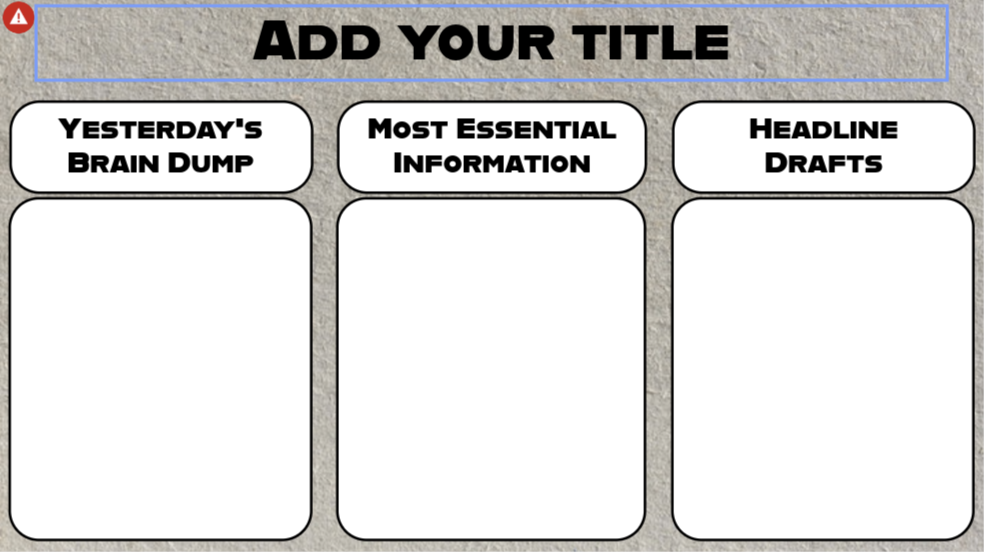
The first is a bellringer activity over the previous day’s lesson. You give them the topic area, and then in three steps, they build their headline. You have them brain dump what they remember. Distill it down. Draft it, and then share their final product. Using these “baby steps” to process their thinking helps create better headlines because it slowly reactivates their knowledge and separates the wheat from the chaff.
The second use case comes after engaging with literally any piece of content. Have them skip the brain dump and write down the essential takeaways from that content. Then, have them write some drafts before sharing their final six to ten-word headline. You want this to be the kind of thing that a journalist would put above the fold.
Here’s why the constraint matters: unlimited space is actually the enemy of thinking. When students can write as much as they want, they often write around the idea without ever landing on it. The headline forces them to commit. You cannot hedge in a headline. You cannot say “there are many factors” in a headline. You have to pick something and mean it.
And what they pick tells you everything about what they understood.
A student who headlines a unit on the water cycle as “Water Goes Around in a Circle” understood the mechanics. A student who writes “Earth Recycles the Same Water Dinosaurs Drank” understood the wonder of it. Both are correct. Only one of them is going to make their classmates lean forward.
A level-up I love: After students write their headlines individually, do a gallery share: everyone reads their headline aloud, and we vote on which one we’d most want to read the article under. The conversation that follows about why certain headlines work is worth its weight in gold.
How I use it: After we’ve gotten good at the routine, we can eliminate the “baby steps” and create no-prep exit tickets. End of class, one sentence, no more. It’s also a killer discussion starter. I’ll have students write their headline before we discuss, and then revisit it after to see if it changed.
Grab the template here →
2. Imagine If…
I need you to try something.
Imagine if gravity worked sideways.
I’ll give you a second.
You just did something that your brain finds genuinely irresistible: you took a rule of the world, broke it, and immediately started building a new world in its place. You probably pictured something specific. You may have started problem-solving. You might have even felt a little giddy, because speculation is fun in a way that straightforward recall almost never is.
Imagine If is a Project Zero thinking routine built entirely on this instinct. The structure is exactly what it sounds like: students take something they’ve been studying and ask, “What if one key thing were different?” What would change? What would stay the same? What new problems would emerge? What would be better? What would be worse?
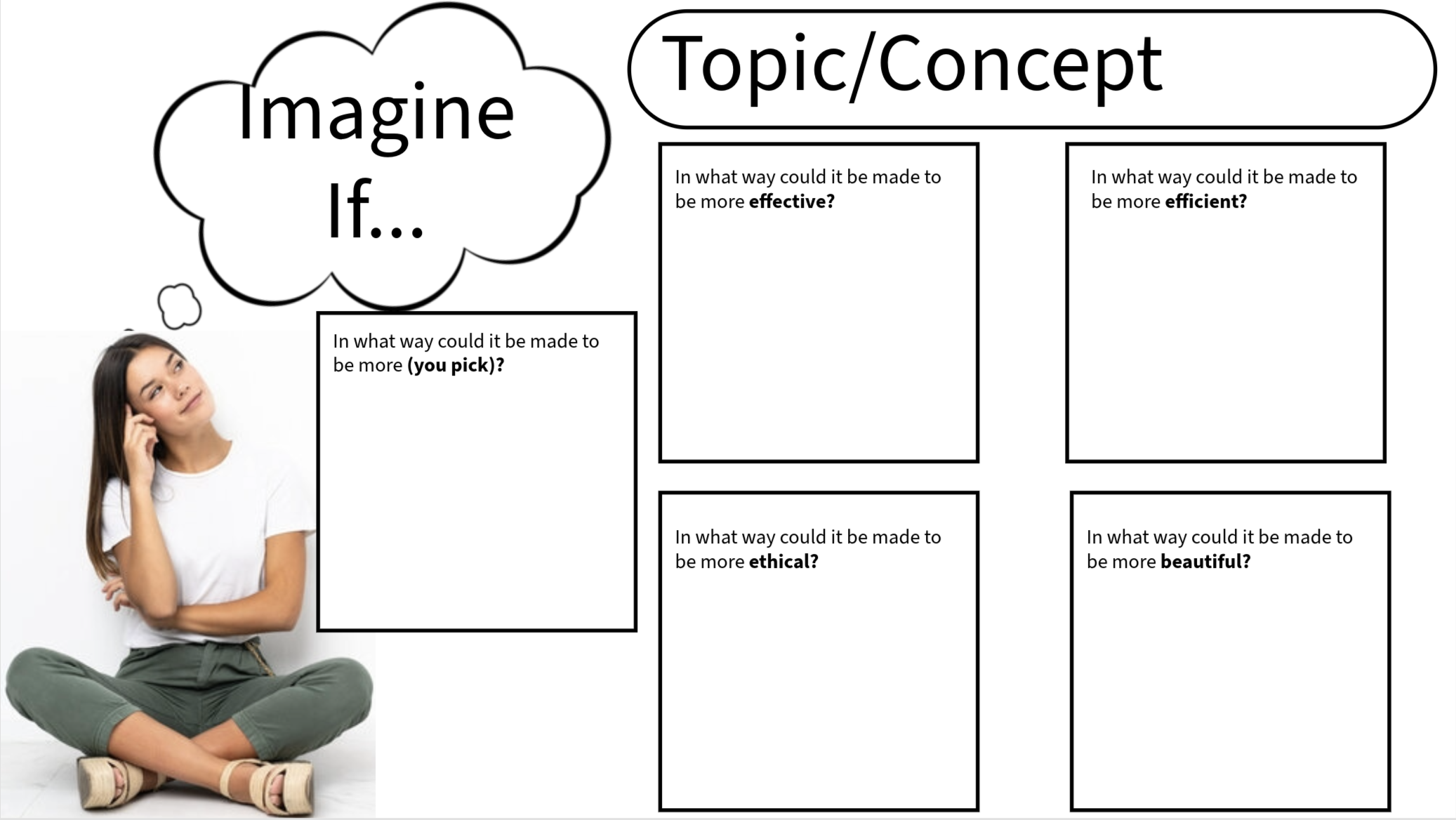
It sounds like a creative writing prompt. It is not a creative writing prompt. It is one of the most rigorous causal reasoning exercises you can run in any classroom.
Because here is the thing: you cannot answer an “Imagine If” question well without understanding how the original thing actually works. If a student says, “Imagine if photosynthesis didn’t exist,” and their answer is “plants would be sad,” they don’t have it yet. But a student who says, “Every food chain on Earth collapses within weeks because the base of every terrestrial food web depends on photosynthesis converting solar energy into chemical energy,” that student has genuinely internalized the concept.
They just showed you by breaking it.
The speculation is the mastery check. The “what if” is the proof of the “what is.”
Some of my favorite prompts across subject areas:
Imagine if the Civil War had ended differently. (History: causal reasoning, long-term consequences)
Imagine if cells didn’t have membranes. (Biology: structure and function)
Imagine if Shakespeare had written in modern slang. (ELA: voice, register, audience)
Imagine if zero hadn’t been invented. (Math: I dare you to try this one. The silence will be different from the bad kind.)
Imagine if a country had no laws. (Social studies: civic reasoning, social contract theory)
How I use it: I love Imagine If as a mid-unit check-in, right when students have enough knowledge to speculate meaningfully but before they’ve finished the unit. It surfaces misconceptions early, generates genuine curiosity, and, my personal favorite, produces the kind of student questions that you absolutely could not have scripted. One student once asked, “Imagine if empathy were a physical sense, like sight, would we have evolved differently?” during a psychology unit, and I had to sit down.
Grab the template here →
3. Listening: Ten Times Two
You might remember this from Post Two.
Looking: Ten Times Two asks students to observe a visual stimulus — a photograph, a diagram, a piece of art — in two rounds of ten observations each. The first round catches the obvious. The second round catches everything the first round missed. It’s one of my most-used routines because it fights the scroll — it teaches students to slow down and look again.
Listening: Ten Times Two is the same idea. Different sense.
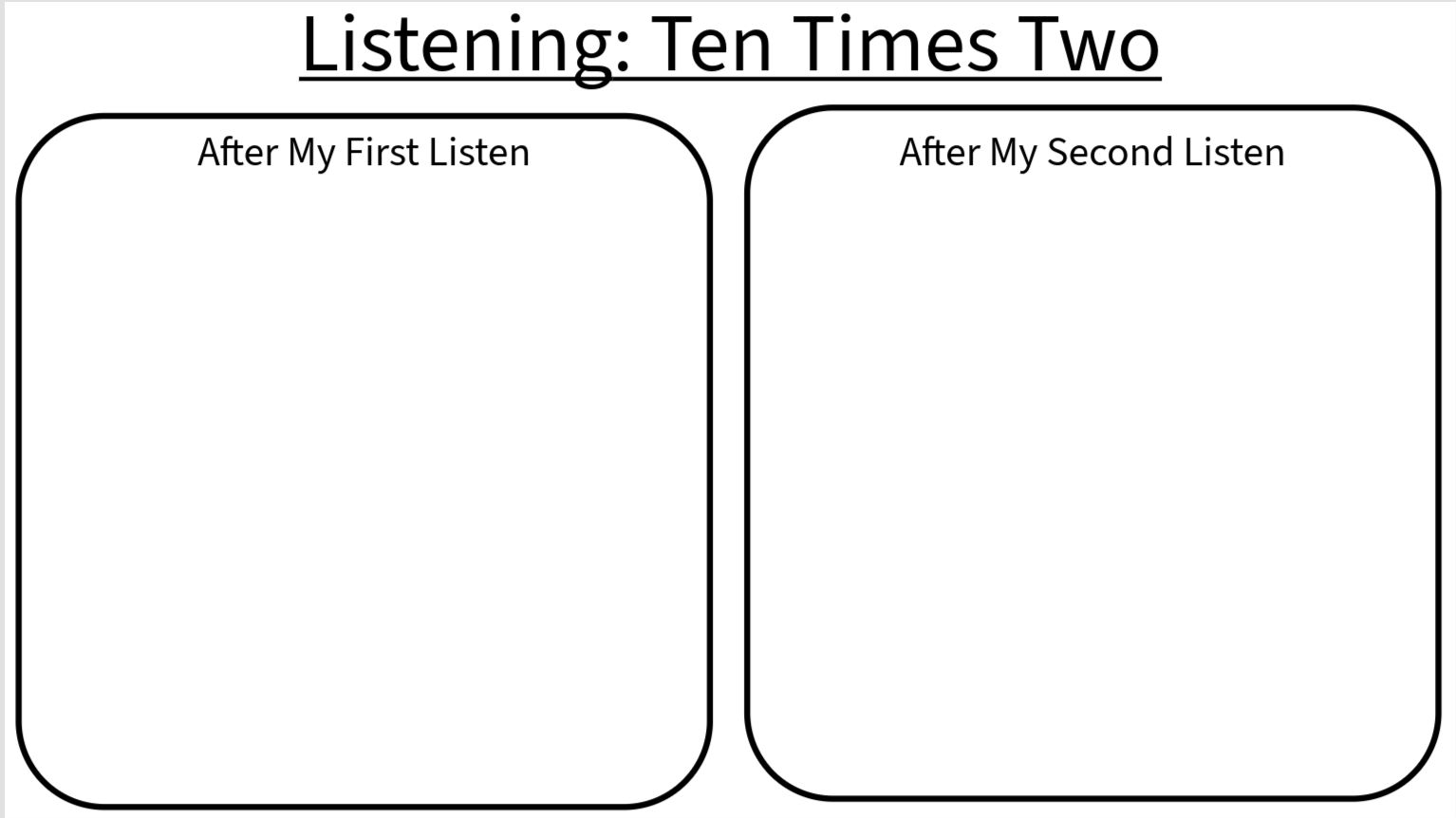
Instead of looking, students listen. This routine was originally constructed for active listening with music. I have found that it works with any non-visual medium. Anything that is experienced through the ears rather than the eyes. They listen once and write down ten words, phrases, or questions. Then they listen again and write down ten more.
Here is why the audio version does something the visual version can’t quite replicate: sound exists in time. You cannot pause a piece of music and examine its corners the way you can squint at a painting. The second listen is genuinely different from the first, not just because you’re paying more attention, but because you already know how it ends, and that changes everything about how you hear the beginning.
The student who listens to a Martin Luther King Jr. speech and catches the rhythm and the repetition on the first pass will catch the silence on the second. Where he pauses. What he leaves unsaid. The places where the crowd erupts and the places where it goes completely still.
That is a level of textual analysis that a worksheet simply cannot capture.
Subject areas where this absolutely slaps:
ELA: poetry, speeches, oral storytelling traditions
Music/Arts: composition analysis, genre exploration, mood, and instrumentation
History: oral histories, period recordings, wartime broadcasts
Science: ambient sound recordings, echolocation, animal communication
World Languages: listening comprehension, accent and inflection, rhythm of speech
How I use it: I pair Listening Ten Times Two with a discussion where students share their second-round observations, specifically, the ones they didn’t catch the first time. These are almost always the most interesting, because they require the most listening to find. I also love using this as an entry event: play something before you tell students what the unit is about, and let their observations become the questions that drive the unit.
Grab the template here →
The Running Thread
Here is what I want you to notice about Headlines, Imagine If, and Listening Ten Times Two.
They are all, at their core, asking students to do the same thing: take something they experienced: read, watched, heard, felt; and turn it into language that means something.
That is not a small ask. It is maybe the hardest cognitive move we make as humans. And it is the one we most often skip in traditional classroom instruction, because it’s easier to check a box than to wait in the silence while a kid finds their words.
But the silence is where the thinking is happening. The routine is just the structure that makes it safe to stay there a little longer.
Your students have thoughts. Genuinely surprising, occasionally brilliant, occasionally chaotic thoughts. These three routines help give those thoughts somewhere to land.
Go find out what they’ve been sitting on.
Templates for all three routines are linked above and also live in the template library. If you missed Part One or Part Two of this series, catch up here: Part One, Part Two. Templates for more PZ routines are coming…I have opinions about a lot of them.