
I have spent the better part of my life constructing arguments.
Since 1998, policy debate tournaments have been a large part of my life. Argument construction is my identity. Arguments are the air I breathe. Competitive debate does something to rewire the way you think about argumentation and the world that is genuinely difficult to explain to people who are outsiders of that world. It makes you see every claim as something that needs support, every position as something that has a counter, every conversation as a map of competing interests that each deserves to be understood on its own terms before you decide what you think.
The problem is that I teach mostly non-debate students who have not been rewired.

I’m ashamed to admit, I forget that sometimes. More often than I should, I walk into a discussion assuming a baseline of argumentative sophistication that my students haven’t had thirty years of debate rounds to develop, and then I wonder why the conversation stays shallow, why students argue from the gut instead of from evidence, why perspective-taking feels like a performance rather than a genuine act of understanding.
These two routines fix that. Not in thirty years. In about forty-five minutes.
This is Post Nine in the Project Zero Thinking Routines series. Circle of Viewpoints and What Makes You Say That are two of the most powerful tools in the library for exactly this reason: they compress decades of debate training into a structure any student can use, in any classroom, on any topic. And they do it by teaching the two things that debate taught me first: how to genuinely inhabit a perspective you don’t hold, and how to demand evidence for every claim…including your own.
Circle of Viewpoints
Here is the problem with most perspective-taking activities in school…they are perspective-acknowledging activities.
Students are asked to list the different stakeholders in a situation. They write down that Group A felt this way and Group B felt that way. They note that there were multiple sides. And then they go back to their own position, which has not moved an inch, because they were never actually asked to inhabit anything. They were asked to catalog viewpoints from the outside, which is a completely different cognitive move than speaking from inside one.
Circle of Viewpoints asks students to get inside.
The routine, developed as part of the Artful Thinking Palette at Project Zero, works in three stages. First, the class brainstorms a list of different perspectives connected to
the topic: every stakeholder, every affected party, every viewpoint worth considering. Not just the obvious two sides. All of them. The farmer, the developer, the environmentalist, the mayor, and the kid who grew up near the river. The scientist, the patient, the insurance company, and the policymaker. Whoever belongs in the circle.
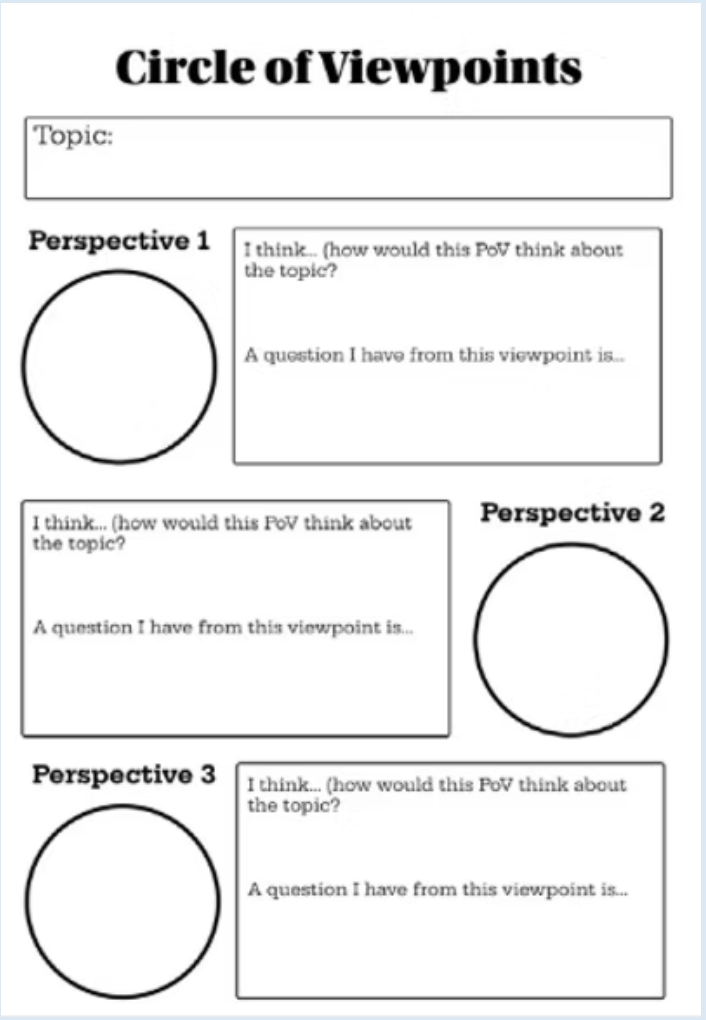
Then students choose one perspective, not necessarily one they agree with, not necessarily the one that feels comfortable, and they speak from inside it, using these sentence starters directly from Project Zero:
I am thinking of [the topic] from the viewpoint of [the viewpoint you’ve chosen].
I think [describe the topic from your viewpoint].
A question I have from this viewpoint is…
That last prompt is the one I love most. Because it asks students not just to argue a position but to notice what that position still wonders about, what it doesn’t have answered, what it’s uncertain of, what it would want to know. It treats the perspective as a living thing with its own curiosity, not just a set of fixed beliefs to be reported.
Project Zero is explicit about when this routine works best: with topics that deal with complex issues, and especially when students are having a hard time seeing beyond two sides. The circle expands the frame. It says: it’s never just two sides. There are always more people in the room than the ones making the most noise.
Here is what happens when students do this well, when they really commit to the character of a perspective they don’t personally hold and argue it with genuine effort: they become harder to fool. They become more difficult to manipulate. Because the person who has genuinely inhabited the perspective of the pharmaceutical company and the perspective of the patient and the perspective of the researcher doesn’t just have opinions about drug pricing, they have a map of the whole argument. And a map is infinitely more useful than a flag planted on one side.
How I use it: Circle of Viewpoints is extraordinary for historical events where multiple groups had legitimate but conflicting interests, for ethical dilemmas in science, for literary analysis where characters are in genuine conflict, and for any current event where the public conversation has collapsed into two loud camps, and the actual complexity is getting lost. I always run the brainstorm as a whole class first — getting the full circle of perspectives on the board together, before students choose one to inhabit individually. The debrief after is where the magic happens: who found it hard to argue their chosen perspective? Who surprised themselves?
Grab the template here →
What Makes You Say That?
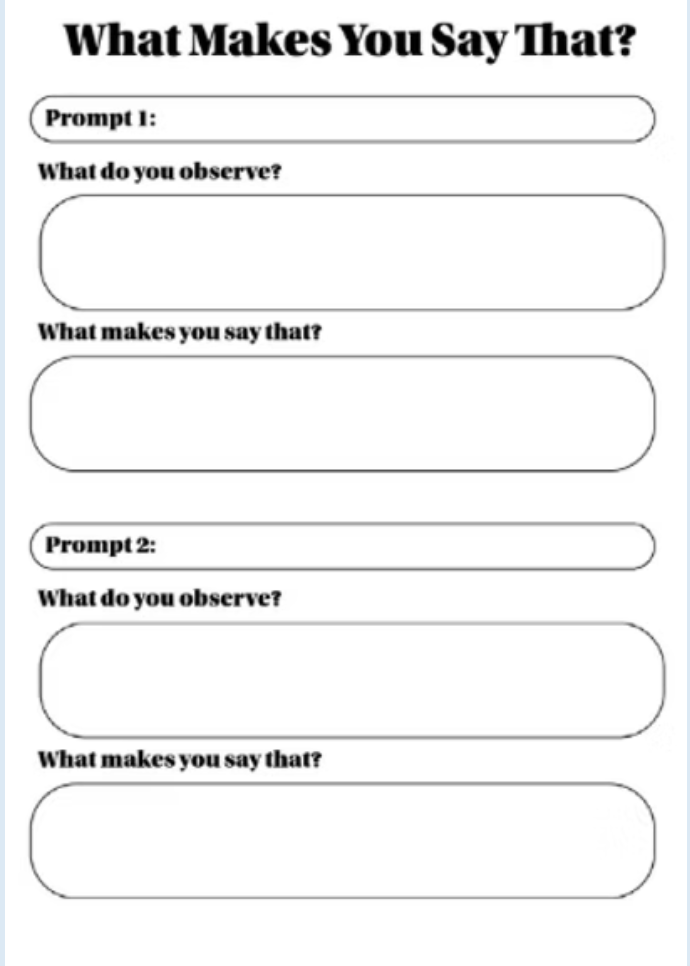
This one is deceptively simple. Two questions. That’s the whole routine.
What do you think or what do you see?
What makes you say that?
That second question is the one that changes everything.
What Makes You Say That is a Project Zero interpretation-with-justification routine, adapted from Visual Thinking Strategies developed by Philip Yenawine and Abigail Housen. The premise is straightforward: every time a student offers an interpretation of: an image, an object, a text, a concept, anything, they are immediately asked to ground it in evidence. Not later. Not after they’ve moved on to the next idea. Right now. What do you see, hear, or read that makes you say that?
The routine sounds like a conversation move, and it is, but it’s also a thinking move. Because the act of answering “what makes you say that?” requires students to trace their own reasoning backward. It requires them to find the specific thing — the word, the image, the detail, the piece of evidence that their interpretation is built on. And sometimes, when they try to do that, they discover their interpretation is built on nothing solid at all. It was a hunch dressed up as an observation. It was pattern-matching masquerading as analysis.
That discovery, catching yourself mid-claim without evidence to support it, is one of the most valuable things that can happen in a classroom.
Project Zero notes that this routine cultivates observation, description, explanation-building, and evidence-based reasoning. When students share their interpretations and justifications with each other, they’re also exposed to the fact that different people can look at exactly the same thing and see completely different things — and that both interpretations might be defensible, depending on what evidence you foreground.
That’s not relativism. That’s rigor.
What makes this routine especially powerful in combination with Circle of Viewpoints is the sequence: Circle of Viewpoints asks students to inhabit a perspective, and What Makes You Say That asks them to defend it. First, you climb inside the viewpoint. Then you have to find the evidence that the viewpoint is built on. Together, they form a complete arc of perspective-based reasoning from “I can see this from where they stand” to “and here is what they would point to as proof.”
One practical note: What Makes You Say That works as a teacher move, not just a structured activity. Once students understand the question, you can deploy it at any moment in any discussion, every time an unsupported interpretation floats past, every time a student makes a claim without evidence, every time the conversation starts to drift from reasoning into assertion. Two words. Six syllables. And the whole room has to slow down and find the evidence.
How I use it: I use What Makes You Say That as both a structured written routine and as a live discussion move, probably more as the latter at this point, because it’s become a habit in my classroom. Students start asking it of each other without prompting, which is the goal. I also love it as a direct follow-up to Circle of Viewpoints: after students have argued from their chosen perspective, they run What Makes You Say That on their own argument. What evidence did you use? What are you seeing that makes you argue this viewpoint the way you argued it? It turns the perspective-taking from performance into analysis.
Grab the template here →
A quick note for those who have been following along: Circle of Viewpoints and What Makes You Say That both made a cameo in the very first post in this series, where I introduced them briefly alongside a handful of other routines. If you grabbed the templates then, you already have them! If you’re just joining us, welcome, and go snag them anyway. The first post was an introduction. This one is the deep dive.
The Thread Running Through Both
Circle of Viewpoints. What Makes You Say That.
One asks students to genuinely inhabit a perspective they don’t hold. The other asks them to find the evidence that perspective is built on.
Together, they are making an argument about what it actually means to understand something, as opposed to merely tolerating it, or acknowledging it from a safe distance, or listing it in a chart alongside three other perspectives you’ve also never really inhabited.
Understanding requires more than acknowledgment. It requires that you can argue the position as if you mean it. It requires that you find the evidence it stands on. It requires the uncomfortable work of climbing inside a viewpoint that might challenge your own, not to abandon what you believe, but to genuinely reckon with what someone else does.
In thirty years of debate, the opponents who changed my thinking were never the ones who defeated me. They were the ones who understood my argument well enough to dismantle it from the inside. Who could see the map of my reasoning before they challenged it. Who made me feel genuinely heard, and then showed me why they still disagreed.
That is what these routines are practicing. And that is what debate taught me that I want every student to have.
Post Ten is coming.
Free templates for all thinking routines in this post are linked above and in the free resource library.
Catching up on the series? [Part One] | [Part Two] | [Part Three] | [Part Four] | [Part Five]| [Part Six]/[Part Seven]/[Part Eight]