Let me tell you something that will either deeply resonate with you or make you close this tab immediately.
I think about thinking. Like… a lot. Embarrassingly a lot. From reading philosophy and psychology texts, to staring into the void and wondering why my silly “lizard brain” likes to do things. It’s all thinking about thinking (think-ception!?!?!?!?). My thinking about thinking runs so wild that when I’m in the middle of the grocery store buying soup, it becomes a whole event. I will literally stare at two nearly identical cans and catch myself running a full Red Light Yellow Light analysis on chunky vs. creamy.
Chunky: maybe it’s too chunky? Yellow light on the chunky.
Why do I do this to myself? I don’t know. But what I do know is that if my brain is doing this automatically at a Dillons (Kroger), on a Tuesday, over soup, then my students’ brains are doing some version of this all the time too.
The problem isn’t that they can’t think.
The problem is that nobody gave them the tools to know they already are.
(before I get to the point, this song immediately popped into my head)
Towards the end of February, I wrote about my love of Harvard’s Project Zero and their thinking routines. If you’re like “WHATARETHOSEEEEE” (silly kids and their memes), most educators are more familiar with these when we talk about visible thinking routines. In that post, I shared a couple of my favorite routines with use cases, templates, and more! (If you want to read the post, check it out here. If you want those templates, you can grab them here!)
1. Who Am I?
On Monday, I wrote that post about interviewing an Oxford Comma? This routine is the spiritual ancestor of that chaos. Who Am I? is a Project Zero thinking routine that asks students to think about identity, specifically, the identity of a concept, object, historical figure, organism, or literally anything you are studying.
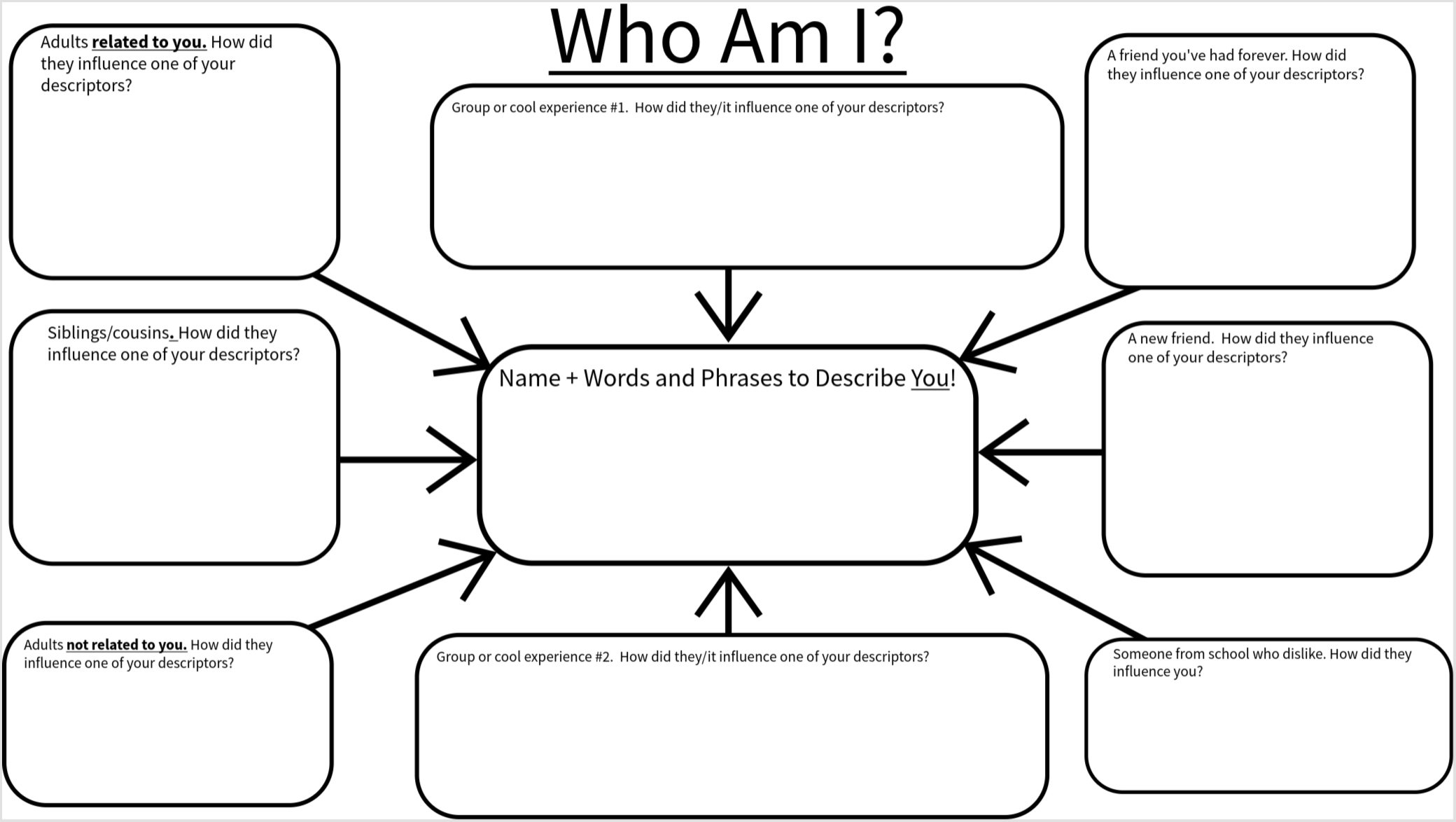
The prompt is simple: students have to answer the question “Who Am I?” from the perspective of the subject matter (or themselves).
But here’s where it gets interesting. They’re not just restating facts. They’re constructing a persona. They’re saying: based on everything I know about this thing, what does this thing value? What does it do? What is it for? What would it say about itself if it could talk?
And that, my friends, is a completely disguised mastery check.
A student who, after tracing any form of influence, writes, “I am photosynthesis. I am the reason you exist, and honestly, you’re welcome. I take your sunlight, your water, and your CO₂, and I build the very sugars that keep every living thing on this planet going. You think food chains start with plants? They start with me,” that student gets photosynthesis. They can discuss it in a way that a fill-in-the-blank process chart will never be able to verify.
How I’ve used it: I love this one as a content review tool. After a unit, students pick a concept from our learning and write a Who Am I? response. We share them out, and the class has to guess what the concept is before the writer reveals it. It turns review into a guessing game with genuine stakes.
2. Looking Ten Times Two
This routine has a name that sounds like it should be a math problem, but it is actually one of the most quietly powerful observation activities I have ever used with students.
Here’s the structure: students look at a piece of art, an image, a graph, a diagram… anything visual…for an extended period of time. Specifically, they look at it for 30 seconds, and afterwards they write down 10 words, phrases, facts, or questions.
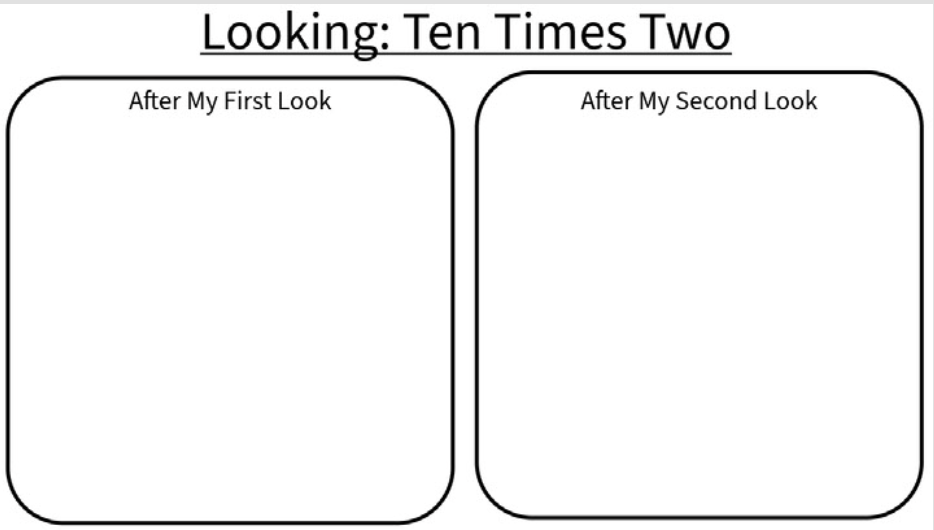
Then they fold their paper in half and do it again.
Hence: Looking: Ten Times Two.
The first round feels easy. The first three observations? Effortless. But on the second iteration, they have to look differently. They start noticing things in the background, things in the negative space, things they absolutely dismissed on their first glance.
The second round is where the real power comes from. Because now they’re noticing things about what they noticed. They’re making connections. They’re asking questions. They’re doing the kind of slow, deliberate looking that we desperately want to cultivate in students who live in a world of 1.5x speed TikTok videos.
We are asking students to fight the scroll. And they do it. Every time I ask them to!
How I use it: I use this at the beginning of a new unit to build background knowledge and generate curiosity. Drop an image in front of them: a historical photograph, a piece of art, a scientific diagram, and let them sit with it. The questions they write in round two become our driving questions for the unit.
3. Reporter’s Notebook
Okay, so you know how every great journalist show has that scene where the reporter flips open a tiny spiral notebook, clicks a pen dramatically, and starts firing questions? That’s the entire energy of this routine, and I am completely here for it.
Reporter’s Notebook is a thinking routine that asks students to approach any piece of content: a text, a video, an experiment, a primary source, like an investigative journalist trying to crack a story.
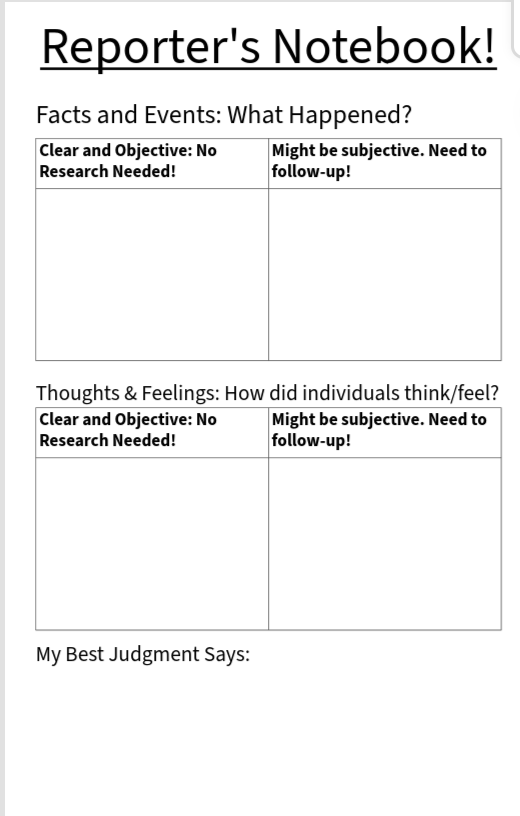
They’re not reading to summarize. They’re reading to interrogate.
We’ve done a great job teaching our students to read for information. We’ve structured their information-seeking around the classic journalist questions: Who? What? When? Where? Why? How?
But we go further than that. We need to ask students to identify facts from opinions. Subjectivity from objectivity. Clear observations of events vs. what is tainted by feelings.
This routine teaches students to be active, critical consumers of information, which, in the current information climate, might be the single most important skill we can give them.
The first time I ran this with a class using a primary source document, a student raised her hand and said, “Wait, but who benefits from this being written this way?” and I had to physically stop myself from doing a fist pump in front of 28 teenagers….but I failed, I did it anyway!
That question? That’s media literacy. That’s critical thinking. That’s the good stuff.
How I use it: Reporter’s Notebook is my go-to for primary source analysis, news article reading, scientific study review, and really any time I want students to engage with a piece of content rather than just consume it. I also love pairing it with the Interviews with Inanimate Objects activity, because once students have interrogated a source like a reporter, they have everything they need to voice a concept in character.
4. Red Light, Yellow Light
We end with my personal favorite. The one I use on soup cans at Kroger without even trying.
Red Light, Yellow Light is a thinking routine that asks students to evaluate claims or ideas the same way a driver approaches a stoplight.
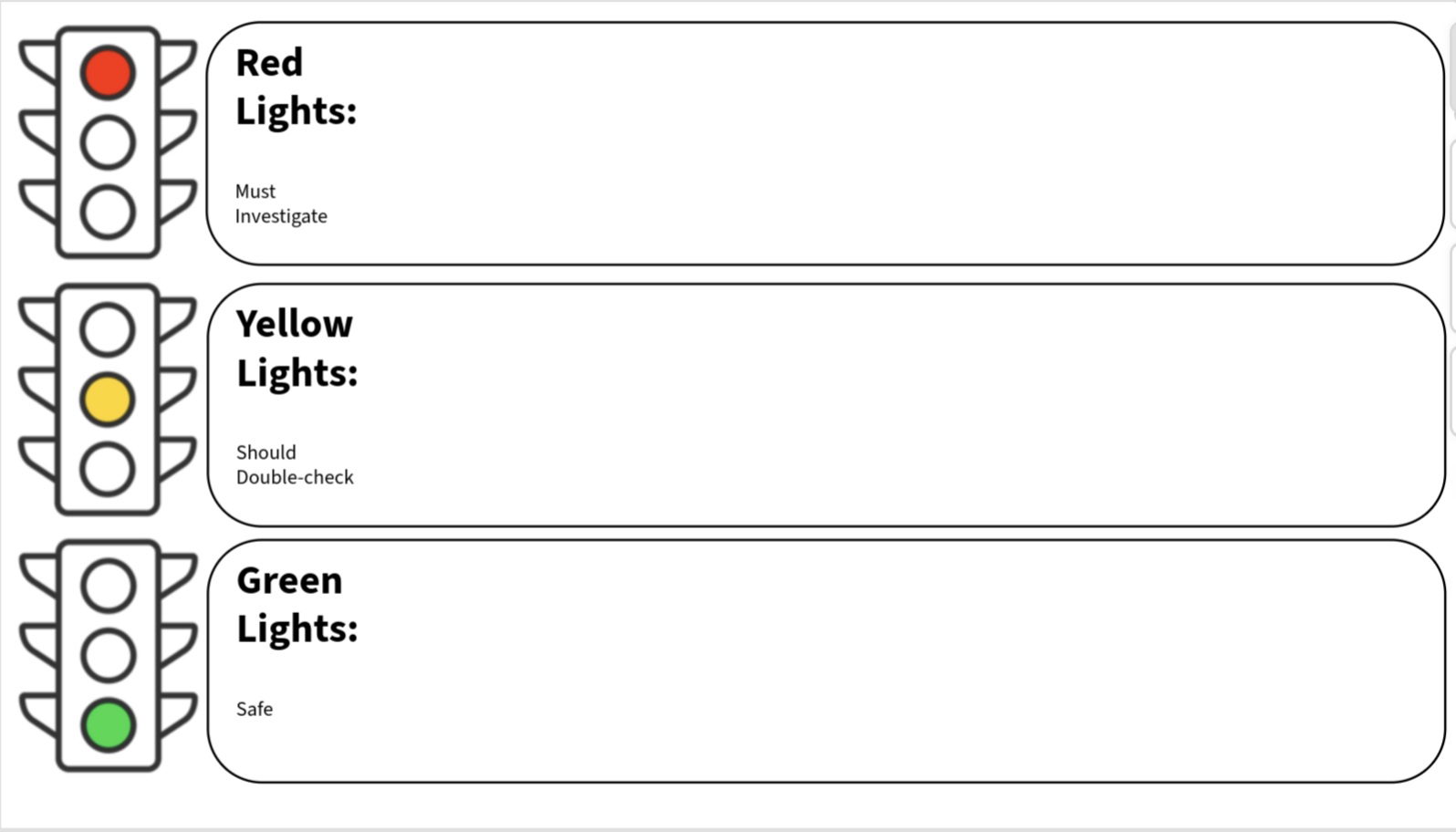
Red light = Something in this claim that makes me want to stop. Something that seems wrong, misleading, or contradictory. A claim I want to challenge.
Yellow light = Something that makes me slow down. Something that’s uncertain, incomplete, or that I want to know more about before I accept it. A claim that needs more evidence before I give it a green.
It’s asking them to sit in productive discomfort: to flag problems and to sit with uncertainty. Both are skills. Both are undervalued in traditional classroom environments where the goal is often to arrive at the right answer rather than to notice the interesting wrong ones.
I love Red Light, Yellow Light for persuasive texts, for scientific claims, for political speeches, and for advertisements. Basically, anything where someone is trying to get you to believe something. While it is a great text-marking strategy, I’ve also started using it with any form of video content they engage with.
The world is trying to get your students to believe things every single day. This routine gives them a framework for asking: should I?
How I use it: I run this one after students read or watch something argumentative. They fill out their Red/Yellow columns individually first, then compare with a partner, and the conversations that follow are genuinely electric, because students who flagged different things have to explain their reasoning to each other. Instant discussion. No discussion starter prompts required.
So, What Now?
Here’s what I want you to walk away with: thinking is not a natural disaster that happens to students on test day. It’s a skill. It’s a set of habits. And the beautiful, slightly unhinged truth is that your students are already doing versions of these things, they’re analyzing, they’re questioning, they’re noticing, they just don’t have the structure to know that’s what they’re doing.
These four routines give them the structure. Your templates give them the scaffolding. And your weird, creative, boundary-pushing classroom gives them the permission!