The Flight Safety Card Activity: What Stick Figures and Oxygen Masks Can Teach Your Students About What Actually Matters
- Dustin Rimmey
- May 18
- 8 min read

Brief Update!
Oh man, nothing like getting injured and sick as heck in the last 10 days of school. For the first time in AGES, I had to leave school last week because I fell physically ill (after making it to my second-floor classroom on crutches nonetheless! But, I'm back to about 90%, we've got 3.5 days until summer, so here are some fun updates before we get to today's wacky template!
Job change! Two weeks ago, I found out that I'm staying in the same school, but transitioning back to a traditional classroom. While I've thoroughly enjoyed my year as an interventionist (and would do it again 10000000 times in a heartbeat), I'm headed back to the world of Social Sciences! So, get ready for some interesting summer prep articles!
The Post Flow: Right now, the plan is to stay with the M/W/F rhythm I've fallen into (tech or ready-made activities, visible thinking, and educational soapboxes). The only change may come during ISTE, where I'll probably write about some of the cool people and things I saw!
Newsletter: I think I'm going to explore starting one in July, just in time for the new school year! If you have any thoughts or suggestions on what it should include, I'm always down for suggestions!
Make Sure Your Seats are in the Upright Position!
Have you ever actually read a flight safety card?
I mean, really read one? Not the panicked skim you do when the flight attendant gives you the look. I mean, sat with it, examined it, thought about what it is actually doing.
It is a masterpiece of compression.
Every flight safety card has to take an enormously complex set of survival information: emergency exits, oxygen mask deployment, brace positions, water landing procedures, flotation devices, and distill it into something a terrified person can process in thirty seconds while sitting in a metal tube hurtling through the air at 500 miles per hour. Nothing extraneous. Nothing decorative. Nothing that does not absolutely need to be there.
Every word earned its place. Every stick figure was a decision.
I think about this every time I watch a student do a unit review.
You know the one I mean. The student who writes everything down. Not a summary, a transcript. Four pages of notes for a one-page review sheet. A highlighter that has touched every single sentence in the chapter because they cannot figure out which ones matter more than the others. The student who, when you ask "what's the most important thing here?" looks at you with genuine, earnest panic because nobody has ever asked them to answer that question before.
That student is not struggling with the content. They are struggling with compression.
Compression is the cognitive act of identifying what is essential, discarding what is peripheral, and organizing what remains into a form that can be used under pressure. It is one of the most sophisticated thinking skills we ask of students. And it is one of the ones we teach least explicitly, because we assume it comes naturally once the content is learned.
It does not come naturally. It has to be practiced. And it turns out there is a format perfectly designed to practice it.
Welcome to the Flight Safety Card activity. Population: every subject area, every grade level, every unit you have ever taught.
You may be thinking to yourself: Surely, he can't be serious.....
...I am serious, and don't call me Shirley!
The Fasten Seatbelt Sign is On!
Why Compression Is a Skill, Not a Talent
Here is the thing about the student who writes everything down.
They are not lazy. They are not inattentive. They are not failing to engage with the material. They are doing exactly what years of schooling have trained them to do: capture information. Record it. Get it down before it disappears.
What they continue to struggle with, what we rarely teach explicitly as students get older, is what to do with it once it is captured. How to look at everything they have written and ask: "Which of these things would I put on a flight safety card?"
Compression is not a natural byproduct of content knowledge. Research on cognitive load theory, developed by John Sweller in the 1980s and refined extensively since, explains why. When students are learning new content, their working memory is already operating near capacity. The mental bandwidth required to simultaneously learn information AND evaluate its relative importance AND organize it hierarchically is often more than the cognitive system can handle at once. The result is that students default to capturing everything, because selective capture requires a second-order judgment they do not yet have the resources to make.
This is not a character flaw. This is cognitive architecture.
The implications for teaching are significant. Research published in Remedial and Special Education found that students who were explicitly taught summarization strategies: identifying main ideas, eliminating redundancy, organizing hierarchically, significantly outperformed students who were simply asked to summarize without instruction. The skill of compression does not emerge automatically from exposure to content. It has to be scaffolded, practiced, and made visible.
This is where the flight safety card format does something that a traditional summary prompt cannot.
A summary prompt says: write less than what is here. A flight safety card says: someone's survival depends on what you put on this card. Every word has to earn its place. Nothing extraneous. Nothing peripheral. Only what absolutely matters, in the order it matters, in a form that works under pressure.
That constraint is not cosmetic. Research on desirable difficulties, a framework developed by Robert Bjork at UCLA, finds that introducing meaningful constraints into learning tasks forces deeper processing, stronger encoding, and better long-term retention. When students cannot write everything down because the format will not let them, they have to make decisions. And making decisions about what matters is the cognitive move that builds the skill of compression.
The flight safety card is a desirable difficulty wearing a very convincing costume.
We Are Beginning our Final Descent
This is the part I get most excited about, because the flight safety card format is genuinely content-agnostic. If it has conditions, consequences, and a way out, it has a card.

History: The French Revolution: what do you need to know before you enter 1789 Paris? The safety procedures are the three estates, the fiscal crisis, and the storming of the Bastille, in that order. The emergency procedures are the Reign of Terror. The exits are Napoleon and the First French Republic. The prohibited items are the assumption that this was purely about liberty and equality; it was also about bread, debt, and decades of institutional failure. A student who can populate all six sections of this card understands the French Revolution at a level that a five-paragraph essay rarely reveals.
Science: A volcanic eruption: destination: Mount St. Helens, May 18, 1980. Safety procedures: magma chamber pressure, lateral blast, pyroclastic flow, in sequence. Emergency procedures: the 57 people who did not make it out, including the geologist who stayed to monitor and the innkeeper who refused to leave. Exits: the slow ecological recovery, the return of life to the blast zone, and the lessons applied to subsequent eruptions. Prohibited items: the assumption that volcanoes are purely destructive, the soil that forms from volcanic material is among the most fertile on earth.
ELA: The world of The Handmaid's Tale: destination: Gilead. Flight duration: indeterminate, which is itself a safety concern. Safety procedures: know your color, know your role, do not make eye contact with the Eyes. Emergency procedures: the Wall, the Salvagings, the Unwomen. Exits: the historical notes at the end of the novel, which tell you that this flight eventually lands somewhere, though not for everyone on board. Prohibited items: the assumption that this is science fiction. Atwood has said every element in the novel has a historical precedent. That is your most important safety warning.
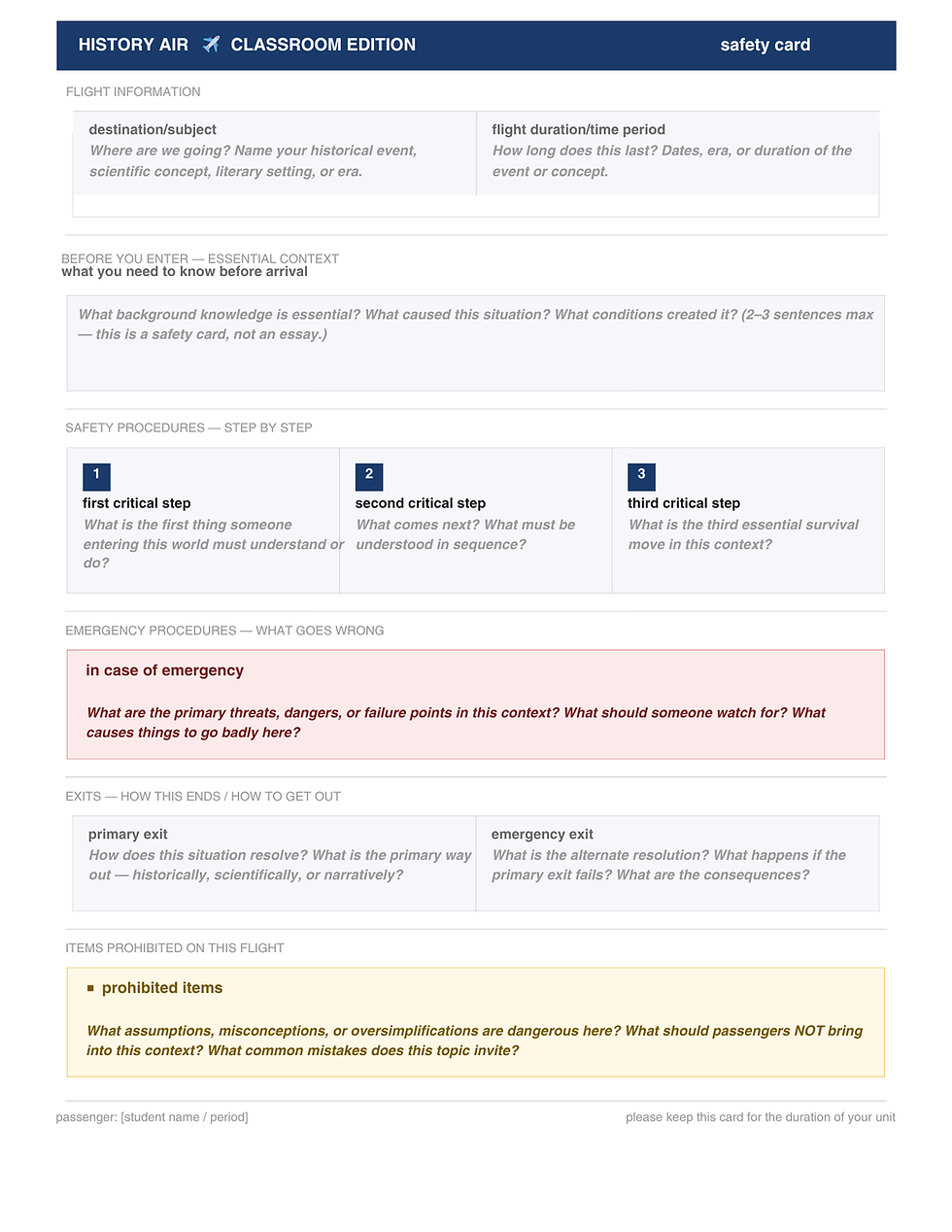
Social Studies/Civics: The Constitutional Convention of 1787: destination: Philadelphia, summer. Safety procedures: the Great Compromise, the Three-Fifths Compromise, and the tension between large and small states. Emergency procedures: the moments the whole enterprise almost collapsed, Gouverneur Morris's late-night drafting sessions, the delegates who left without signing, the Anti-Federalist opposition that nearly prevented ratification. Exits: ratification, the Bill of Rights as the price of adoption. Prohibited items: the assumption that the Founders were unified — they disagreed about almost everything and compromised their way to a document that satisfied nobody completely and everybody enough.
Science: Biology: The human immune response: destination: your body, approximately 72 hours after pathogen exposure. Safety procedures: innate immune response, adaptive immune response, and antibody production in sequence. Emergency procedures: cytokine storm, autoimmune response, immunodeficiency. Exits: recovery, memory cell formation, vaccination as the preloaded safety card. Prohibited items: the assumption that a stronger immune response is always better; sometimes, the immune system is the thing that kills you.
World Languages: Any target language country or cultural context: destination: a first-year student arriving in France, Japan, or Mexico. Safety procedures: the three most critical cultural norms that will prevent offense or confusion. Emergency procedures: the faux pas that will get you in the most trouble, culturally speaking. Exits: how to recover from a cultural misstep gracefully. This version of the card is an assessment of cultural competence rather than content knowledge, and it works at every proficiency level.
Math: Any complex proof or mathematical concept: destination: non-Euclidean geometry. Safety procedures: the three assumptions you have to abandon from Euclidean geometry before you can proceed. Emergency procedures: the conceptual pitfalls that trap students who try to apply flat-plane logic to curved-space problems. Exits: the applications in GPS, general relativity, and modern physics. Prohibited items: the assumption that parallel lines never meet. They do. That is the whole point.
The rule is the same as it always is with these templates. If it has conditions that produce it, consequences that follow from it, and a way out, it has a flight safety card waiting to be written. And the student who can write a convincing one understands it in a way that the student who wrote everything down in the unit review never quite does.
As We De-Plane
I want to come back to that student one more time.
The one with four pages of notes for a one-page review sheet. The one whose highlighter has touched every sentence in the chapter. The one who looks at you with genuine panic when you ask what the most important thing is, not because they do not know the content, but because nobody has ever asked them to decide what matters most.
That student is not failing. That student has been succeeding at the wrong task.
We taught them to capture. We rewarded capture. We gave them notes to copy, slides to photograph, and study guides that pre-digested the content so efficiently that the work of deciding what mattered was done for them before they ever had to do it themselves. And then we handed them a standardized test, a college essay, a job interview, a life full of moments that require them to look at everything they know and figure out what is actually worth saying, and we wondered why they froze.
Compression is the skill we forgot to teach. And the flight safety card is one way to start teaching it.
Not because it is magic. Not because a single activity will undo years of passive note-taking. But because the format makes the demand explicit in a way that a traditional prompt cannot. Every word has to earn its place. Nothing extraneous. Nothing peripheral. Only what absolutely matters, in the order it matters, in a form that works under pressure.
That is what the flight attendant hands you before takeoff. That is what your student is building when they fill out this card. And somewhere in the act of deciding what goes on it — what makes the cut and what gets left behind — they are practicing something that will serve them long after they have forgotten the content of any specific unit.
Figure out what matters. Say it clearly. Leave everything else on the ground.
That is not a flight safety instruction.
That is the whole education.

Comments