
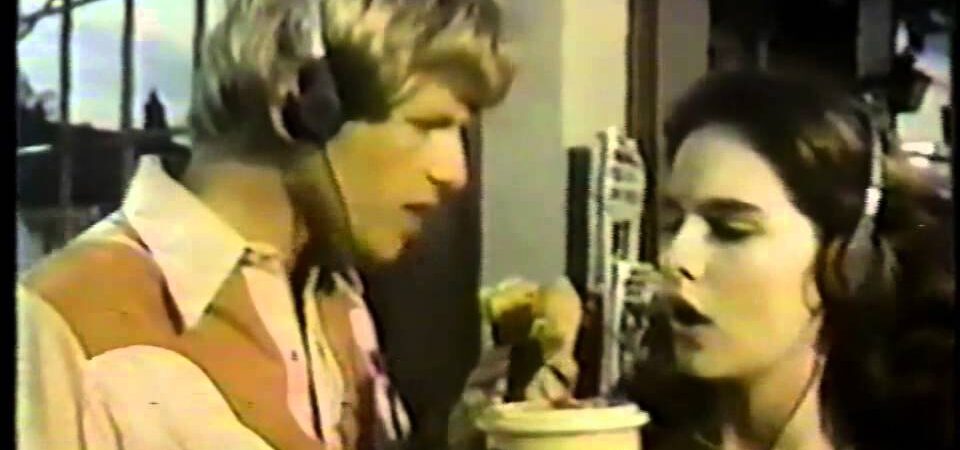
There is a Reese’s Peanut Butter Cup commercial that lives rent-free in my brain. It is one of those commercial gems that then morphs into other shower-thought style derivations.
You probably know the one. Two people walking toward each other, completely oblivious. One has chocolate. One has peanut butter. They collide. And the result is the greatest food combination in the history of human civilization.
It is, when you think about it, a missed connection that actually connected. A what-if that became a what-is.
Whenever this commercial pops into my brain, my thoughts immediately wander to when Craigslist “missed connections” posts started going viral. The dramatic ones. The ridiculous ones. The ones where someone writes three paragraphs about a person they locked eyes with for four seconds on the subway and never spoke to. The ones that are so specific and so earnest and so completely unhinged, a textual car crash that is impossible to look away from.
Then I think about history. And literature. And science. And I think about all of the things that almost connected and didn’t. The treaties that almost held. The discoveries that almost happened a century earlier. The characters who were in the same room and walked out without changing each other’s lives.
What if the United States had joined the League of Nations? What if Gatsby had actually gotten Daisy? What if the supply had found the demand before the market collapsed?
Those are not idle questions. Those are some of the most rigorous cognitive moves a student can make. It turns out there is a format perfectly designed to help them do it.
Welcome to the Craigslist Missed Connections activity. Population: every subject area you have ever taught.
What Counterfactual Thinking Actually Is
Before we explore the template, I want to make sure you understand why this particular thinking move is worth building an activity around.
Counterfactual thinking, the cognitive act of imagining how things could have turned out differently, is not daydreaming. It is not speculation for its own sake. It is one of the most sophisticated and productive forms of human reasoning, and it has been studied seriously for decades.
Daniel Kahneman and Amos Tversky, whose work on human cognition you may know from Thinking, Fast and Slow, pioneered the study of counterfactual thought in 1982. Their foundational finding was that people naturally think “if only” most intensely about exceptional events, the moments where something almost went differently, where the gap between what happened and what could have happened is most visible. History, literature, and science are full of exactly those moments. Which means they are the perfect terrain for counterfactual thinking.
A cognitive neuroscience review published in Frontiers in Human Neuroscience in 2015 describes counterfactual reasoning as a hallmark of human thought, one that enables learning from past experience, supports planning and prediction, drives creativity and insight, and gives rise to the kinds of emotional and social judgments that make us care about what we study. The researchers put it plainly: without considering alternatives to reality, we must accept the past as having been inevitable. Counterfactual thinking is what gives us the flexibility to imagine possible futures and prepare for them.
That is not a soft skill. That is the architecture of human intelligence doing something that no search engine, no AI, and no multiple-choice test can replicate.
Why It Makes Students Better Learners
Here is where the research gets genuinely exciting for educators.
Researchers at the University of Toronto have found that counterfactual reasoning prompts scaffold children’s scientific reasoning skills. Specifically, their ability to form and test hypotheses, design controlled experiments, and transfer reasoning strategies across unfamiliar problems. When students are asked to think “what would have happened if X had been different,” they activate the same cognitive machinery they use in scientific inquiry. They are not just imagining. They are reasoning causally about variables, outcomes, and the relationship between the two.
A 2022 paper published in Frontiers for Young Minds notes that counterfactual thinking spurs scientific reasoning skills and helps students make smarter decisions, and crucially, that children as young as four and five are capable of counterfactual reasoning when the task is appropriately structured. This is not a skill reserved for AP students. It is a fundamental human cognitive capacity that good instruction can develop at any age.
Perhaps most excitingly for those of us obsessed with curiosity, and if you have been reading this blog for any length of time, you know I am very much in that category, a paper published in Philosophical Transactions of the Royal Society B: Biological Sciences on counterfactual curiosity found that when students engage with counterfactual questions, it creates a positive feedback loop. Understanding what might have been increases a student’s desire to seek out more counterfactual information in the future. In other words, asking “what if?” makes students more curious. And as I argued in a recent post, curiosity is the root of everything worth teaching toward.
One important caveat worth naming before you assign this: research also suggests that vague counterfactual musing, the kind that lets students feel like they have engaged with a question without actually doing analytical work, can produce a false sense of learning. That is why the structure of this template matters. The Craigslist Missed Connections format forces students to be specific, causal, and evidence-based in their counterfactual thinking, rather than just imaginative. The format is what makes the rigor possible.
What the Craigslist Format Does That a Prompt Cannot (+ Sample Classroom Activities)
I have assigned counterfactual essay prompts before. “How might history have been different if X had not happened?” They work. Students write responses. The responses are fine.
But fine is not the same as engaged. And engaged is not the same as genuinely thinking.
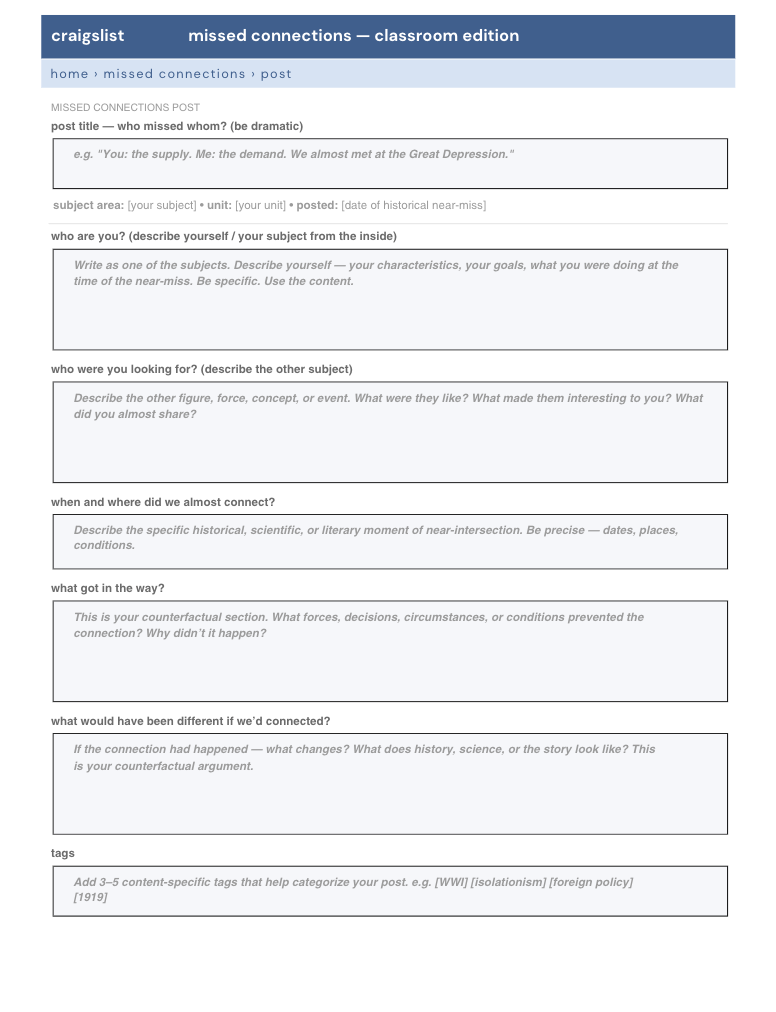
The Craigslist Missed Connections format does something a traditional prompt cannot: it gives students a voice, a perspective, and a dramatic stake in the outcome. They are not writing about the missed connection from the outside. They are writing as one of the subjects, the historical force, the literary character, the scientific concept, looking back at the moment of near-intersection with longing, regret, or frustration.
That shift from third person to first person changes everything. Students have to understand their subject from the inside. They have to know what it wanted, what it was doing at the moment of near-miss, what it understood about the other party, and what it believes would have been different if the connection had actually happened.
The template has five core sections, each doing specific cognitive work:
The title compresses the entire counterfactual into a dramatic headline. Students who cannot write a title that captures the near-miss do not yet understand it well enough.
The “who are you” section requires students to inhabit their subject — to write from inside a historical force, a literary character, or a scientific concept with enough specificity and accuracy that the reader knows exactly who is speaking.
The “who were you looking for” section requires students to understand the other subject well enough to describe it from the outside, which means understanding both parties in the near-miss, not just one.
The “what got in the way” section is the analytical heart of the activity. This is where students have to name the specific forces, decisions, conditions, and circumstances that prevented the connection. Vague answers fail here. Specific, evidence-based answers succeed.
The “what would have been different” section is the counterfactual argument itself.
Students have to reason causally from the missed connection to its potential consequences and do so with enough specificity and logic that the argument is convincing rather than merely imaginative.
The optional comments section adds perspective-taking: other figures, forces, or characters responding to the post from their own point of view.
Together, these sections require students to demonstrate content mastery, causal reasoning, perspective-taking, and counterfactual argumentation in a format that feels nothing like a test.
Where It Works Across Subject Areas
This is the part I get most excited about, because the Craigslist Missed Connections format is genuinely content-agnostic. If it has a near-miss, it has a post.
Shoutout to my buddy Claude for helping me draft ideas in the content areas where I’m weaker!
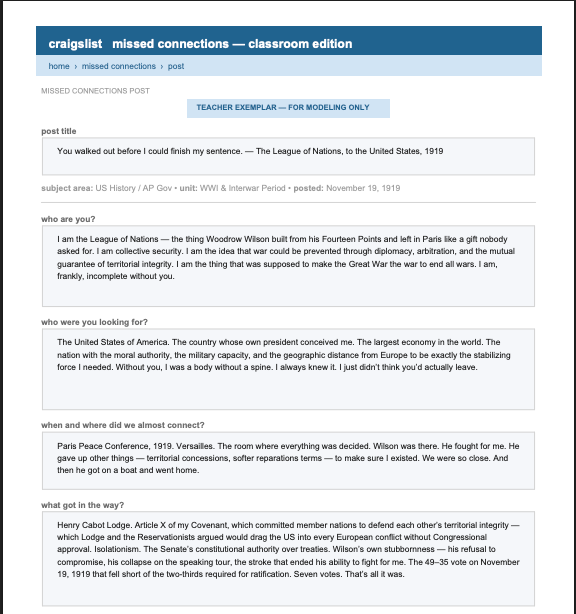
History: The United States and the League of Nations — written from the League’s perspective, mourning the member that never showed up. The Confederacy and British recognition — what if King Cotton had actually been enough to bring the British into the war? The assassination of Archduke Franz Ferdinand and the diplomatic resolution that almost happened in the weeks before — written by the summer of 1914 itself, watching the window close in real time. Reconstruction and the land reform that never came — forty acres and a mule, writing a missed connection to the political will that abandoned it before it could matter.
ELA: Gatsby and the green light — five years of longing compressed into a Craigslist post that Daisy will never read. Romeo and Juliet and the letter that didn’t arrive in time — written by Friar Lawrence, who has some explaining to do. Lennie and the dream farm in Of Mice and Men — the life that was always just out of reach, described by someone who never stopped believing in it. Hester Prynne and the society that could have chosen compassion instead of condemnation — written by the scarlet letter itself, which has opinions.
Science: A virus and the host species it never quite adapted to — what would the outbreak have looked like if that one mutation had happened? Mendel’s genetics research and the scientific community that ignored it for thirty-five years — written by the pea plants, who are frustrated and would like some credit. A tectonic plate and the continent it almost joined — geology as romantic tragedy, complete with a dramatic closing line about continental drift.
Economics: Supply and demand during a market failure — the market that almost cleared, written by the invisible hand on a particularly bad day. The New Deal and the full employment that almost happened before the recession of 1937 reversed the gains. A small business and the loan it almost received before the bank collapsed in 1929 — written from inside the business, which had a really good idea and deserved better.
Social Studies/Civics: The Voting Rights Act and the communities it almost reached sooner — written by the voters who were there but not yet protected. A proposed constitutional amendment that failed ratification by two states — so close, written by the amendment itself. The diplomatic cable that arrived twelve hours too late — bureaucracy as villain in a missed connection that changed the course of a conflict.
World Languages: A language and its near-sister dialect that almost merged — written in the target language for an extra layer of authenticity and linguistic depth. Two cultures that almost made sustained contact through trade routes that collapsed — what would the exchange of ideas have looked like if the ships had kept coming?
Math: Fermat’s Last Theorem and the proof that Fermat claimed to have in the margin but never wrote down — written by the mathematical community that spent 358 years looking for it and has feelings about the whole situation. Euler and the problem he almost solved before running out of time. The mathematician and the collaborator who never met — what happens to the field if they do?
Art/Music: Van Gogh and the recognition that arrived twenty years too late — written by the paintings, which were always ready. Mozart and the commission that fell through — written by the symphony that was never finished. Two artistic movements that almost influenced each other before geography and circumstance intervened.
The rule is simple. If something almost happened, if there is a gap between what was and what could have been, there is a Craigslist post waiting to be written. The format works wherever the what-if lives. And the what-if lives everywhere.
The Missed Connection That Changed Everything
Here is the thing about that Reese’s commercial.
The chocolate and the peanut butter did not plan to meet. There was no strategy. No lesson objective. No rubric for what a successful collision would look like. Two things moving through the world on their own trajectories happened to intersect at exactly the right moment, and something remarkable came out of it.
Most missed connections do not end that way. Most of them are just missed. The treaty that almost held. The letter that arrived too late. The mutation that didn’t happen. The political will that evaporated before it could become policy. The peanut butter that never met the chocolate.
And here is what I want your students to understand, in their bones, by the time they finish writing their post:
History is not inevitable. Literature is not fixed. Science is not a straight line from question to answer. These are fields full of near-misses, contingencies, and moments where the tiniest change in conditions would have produced an entirely different world. The ability to see those moments, to stand inside them, to understand what almost was and why it wasn’t, is one of the most powerful things a student can learn to do.
It is also, not coincidentally, one of the things AI cannot do for them. AI can summarize what happened. It can retrieve the facts of the near-miss. What it cannot do is stand inside the League of Nations in November 1919 and feel the specific weight of seven missing Senate votes. What it cannot do is write as Friar Lawrence, knowing what he knows, carrying what he carries, and make that feel true.
That is your student’s job. And the Craigslist format helps them do it.
Grab the Template
The template includes the blank version for students and a fully worked exemplar, the United States and the League of Nations, that you can use to model the activity before students tackle their own. The exemplar includes a reply from Henry Cabot Lodge, which I encourage you to read even if you already know how this story ends. He is not wrong, exactly. And that is the whole point.
If your students write one that makes you stop and read it twice, tag me. @justrimmey on twitter, @teachersplaiground on Instagram.
And if anyone finds a way to make a peanut butter and chocolate missed connection work as a chemistry assignment — I am absolutely here for it.