
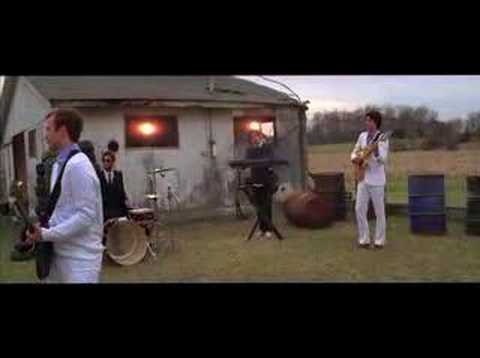
In 2008, American rock band Vampire Weekend shook the world by asking one simple question…” Who gives a F$%K about an Oxford Comma?” and my brain immediately thought two things:
I do…
What does the Oxford Comma feel about this song?
I cannot be the only person who asks hard-hitting questions like this. I definitely know that I’m not the only one who has conversations with inanimate objects frequently.
Do you think I sound a little crazy? If you’ve ever bumped into a piece of furniture and instinctively said “sorry,” congratulations! You’re officially weird like me, and may enjoy today’s weird activity to kick off your week!
Humans have a deeply weird, completely universal habit of giving feelings to things that don’t have hearts. We name our cars. We apologize to tables. We root for the underdog robot in every science fiction movie ever made. The human brain is wired for anthropomorphism; we understand the world through the lens of personality, relationship, and emotion far more naturally than we understand it through the lens of definition and diagram.
So why are we still handing students a textbook and asking them to memorize what a mitochondrion is when we could ask them to find out what it wants?
Interviews with Inanimate Objects
The concept is simple: give a concept a voice, a vibe, and a grievance — then put it in the hot seat.
One student plays the journalist. One student plays the object, concept, law, or historical document. (Or you act as the journalist, and all of your students act as the subject.) The journalist asks three hard-hitting questions. The object answers in character and in doing so, must demonstrate a deep understanding of its own function, limitations, and relationship to the rest of the curriculum.
It sounds like improv theater. It is improv theater. It is also one of the most rigorous mastery checks you will ever run in your classroom.
Here’s why: if a student can explain why the Oxford Comma feels ignored in a world of casual texting, they understand what the Oxford Comma actually does. If a student can articulate why Zero is offended by being called “nothing,” they understand Zero’s mathematical significance. You cannot fake the feelings of a concept you don’t understand. The personality reveals the knowledge.
What Does the Interview Look Like?
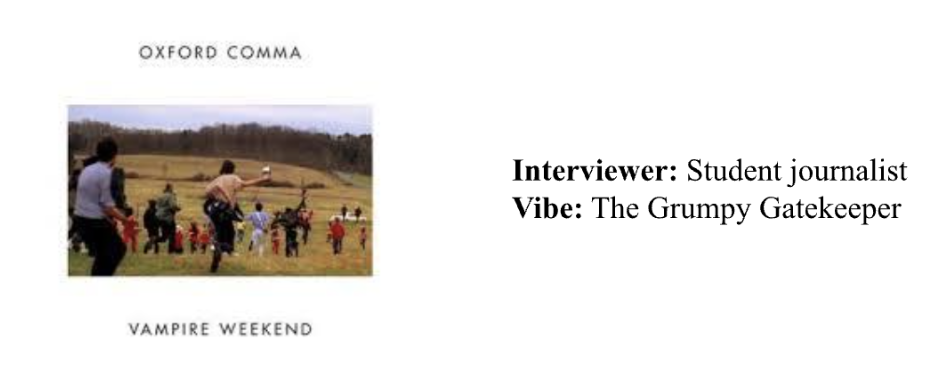
Q: Oxford Comma, how would you describe your role in the English language?
I prevent chaos. Without me, you could dedicate a book ‘to my parents, Beyoncé and God.’ I am the difference between clarity and catastrophe. You’re welcome.
Q: Who is your biggest rival?
AP Style. They banned me. Do you know what it feels like to be banned by journalists? People whose entire job is clarity? The irony is suffocating.
Q: What do students always get wrong about you?
They think I’m optional. I am not optional. I am a load-bearing grammatical structure. Remove me, and entire sentences collapse into ambiguity. I didn’t choose this life; this life chose me.
Q: Any final words?
Use me. Always use me. And tell your AP Style friends I said they’re wrong.
Getting Started: The Talk Show Rundown
Think of some of the greatest modern interviewers, especially on late-night television (which our students probably get through YouTube shorts or on TikTok). What has not gone out of style, as the hosts change on these shows, is the handheld note/cue cards that they use as interview prompts.
To get started, I’ve created two versions of the same “talkshow rundown template.” One of them, you can have students use physical or virtual note cards. The other is the same set of questions, but in a worksheet style.
Click on the image to create your own copy of the interview questions as a Canva template.
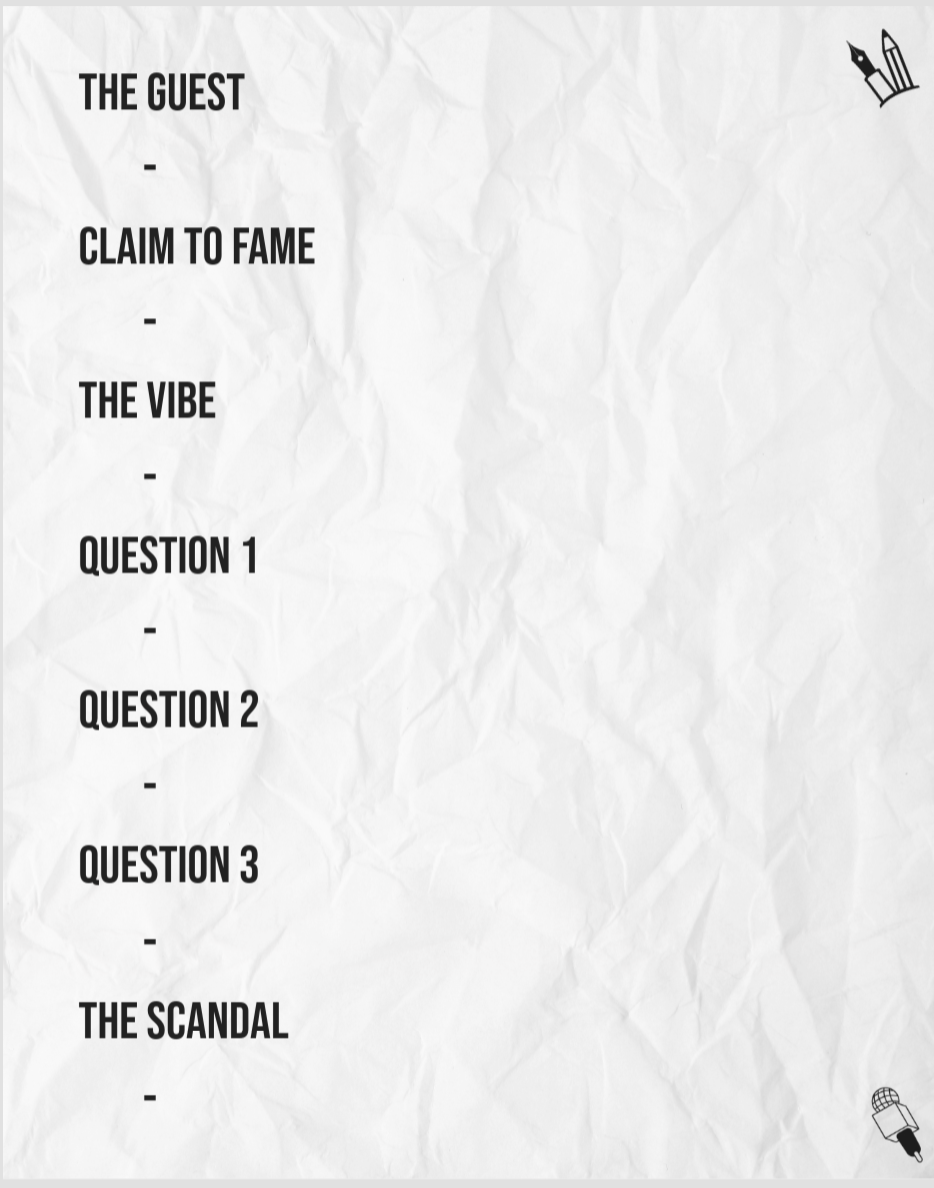
Or you can grab the Adobe Express version of the template here!
Each rundown includes:
The Guest: the concept being interviewed.
Claim to Fame: their one-sentence elevator pitch.
Vibe: the personality they’re bringing to the interview (The Overachiever, The Misunderstood Villain, The Reluctant Revolutionary).
Three Hard-Hitting Questions with response boxes.
The Scandal: a common misconception the guest must address.
The Headline: a one-sentence tabloid-style summary the student writes at the end.
The Vibe and the Headline are the two most important fields. The Vibe forces students to make an interpretive decision about the concept’s personality before they start writing or answering, which requires them to understand its function. The Headline forces them to synthesize the entire interview into a single punchy sentence, which is essentially a 10-word summary in disguise.
What might be the trickiest for either teachers or students is to create personas for the objects being interviewed. Feel free to try one of these personas in your next interview!
The 12 Interview Personas
The Overachiever: Convinced they are the most important thing in the room. Takes full credit for everything, including things they only partially contributed to. Will not stop talking about their accomplishments.
The Misunderstood Revolutionary: Changed everything and got no credit for it. Has been waiting centuries for someone to finally ask the right questions. Slightly bitter. Mostly justified.
The Grumpy Gatekeeper: Exists to enforce the rules and takes that job extremely seriously. Has zero tolerance for exceptions, shortcuts, or people who think the rules don’t apply to them.
The Exhausted Enabler: Has watched the same mistakes happen over and over again and is running out of patience. Deeply invested in the outcome but powerless to stop the inevitable.
The Reluctant Revolutionary: Never asked to change the world. Was just doing their job. Is mildly horrified by the consequences of their own existence.
The Nihilist: Has seen too much. Operates on a cosmic scale that makes human concerns feel insignificant. Not trying to be dramatic — it’s just their reality.
The Defensive Bureaucrat: Under constant attack and fully prepared to justify every decision ever made. Has a lot of paperwork to back them up. Will cite it.
The Charming Liar: Incredibly likable. Possibly completely untrustworthy. The most fun interview in the room and the one you should believe least.
The Lone Wolf: Operates by their own rules. Doesn’t need anyone else. Has a very specific set of conditions under which they will cooperate, and those conditions are non-negotiable.
The Underappreciated Genius: Has been doing incredibly important work for years and nobody has noticed. Not angry. Just disappointed. Would appreciate a thank you.
The Accidental Revolutionary: Set out to do something small and completely ordinary. Accidentally changed the course of history. Still processing it.
The Idealistic Revolutionary: Full of big promises and genuine conviction. The gap between their stated values and the messy reality of implementation is where the most interesting conversations happen.
A Technological Level-Up
In October, I wrote about one of my favorite features in Adobe Express, animating your own voice!
Using voice animation in Adobe Express is a fantastic way to boost your students’ engagement and creativity. This tool allows them to bring characters to life simply by using their own voices, turning what could be a mundane assignment into an exciting, interactive project. You could have them turn their object/concept into a character, and record the interview responses!
By incorporating voice animation, you can easily foster crucial 21st-century skills like digital literacy, communication, and creative problem-solving, all while making learning more memorable and enjoyable.
Students Take the Wheel
Like any great activity, Interviews with Inanimate Objects gets more powerful the more ownership you hand to your students. Here are four ways to escalate the challenge once your class has played a few rounds:
Students Write the Questions
After learning a concept, ask students to generate the three hardest-hitting interview questions before anyone answers them. The question-writing itself is a mastery check in disguise; you cannot write a genuinely challenging question about something you don’t understand. The questions your students produce will also tell you more about their comprehension than any quiz ever could.
The Hostile Witness
Introduce a second concept as a rival who interrupts the interview to dispute the subject’s claims. A student playing The Immune System suddenly has to defend their answers against a student playing An Autoimmune Disease who keeps interjecting with “that’s not the whole story.” The academic argument that follows is pure gold.
The Fan Mail
After the interview concludes, the audience writes two things: one fan letter and one piece of hate mail to the interviewed concept, both grounded in academic content. The fan letter explains why the concept is essential. The hate mail explains its limitations, failures, or unintended consequences. Both require a genuine understanding to write well.
The Spin-Off
At the end of the interview, the class votes on which related concept deserves its own interview based on something that came up in the conversation. If the Doppler Effect mentioned Edwin Hubble, maybe Hubble gets the next hot seat. The curriculum starts to write itself.
Why This Works
When a student can explain a concept’s feelings, its limitations, its rivalries, and its grievances, they have achieved a level of mastery that a standard worksheet simply cannot touch. They aren’t reciting a definition. They are inhabiting a perspective. And perspective, as any great teacher knows, is the hardest cognitive skill to teach.
The textbook gives students the polished PR version of every concept. Interviews with Inanimate Objects tears off the press release and asks: What’s really going on in there?
Your mitochondria has been called a powerhouse for decades. Don’t you think it’s time someone finally asked how it feels about that?
If you’ve made it to the bottom, I’ll share a secret with you…I’m writing a book about getting weird with your students. This, and the taboo lecture, are two examples that are floating around in the very EARLY draft, but I’m excited to keep sharing my lessons and ideas with you!