

Will Ferrell once played legendary Cubs announcer Harry Caray on SNL. If you’ve never seen it, the bit is basically: Harry Caray is a man completely unmoored from social norms, asking the most unfiltered, bizarre questions imaginable: to scientists, to astronauts, to anyone fortunate enough to sit across from him, with zero apology and maximum enthusiasm.
At one point, Harry says, completely unprompted: “I’m curious like a cat. My friends call me Whiskers.“
And here’s the thing. That line is a joke. It’s absurd. It’s peak Will Ferrell chaos.
But also? Harry Caray was right.
Curiosity: real, unbothered, what-if-the-moon-were-made-of-ribs curiosity, is a superpower. And kids are basically born as little Harry Carays. Asking everything. Embarrassed by nothing. Deeply, genuinely, almost aggressively interested in the world around them.
And then they go to school.
I recently read Isabelle Hau’s piece in Educational Leadership, “Curiosity, Connection, and the Future of Learning,” and I have not been able to stop thinking about it since. It puts hard neuroscience behind something most of us have already felt in our bones. We are not just failing to cultivate curiosity in our students.
We are actively, systematically draining it out of them.
And here’s the data to prove it.
The Statistic That Should Be on Every Staff Room Door
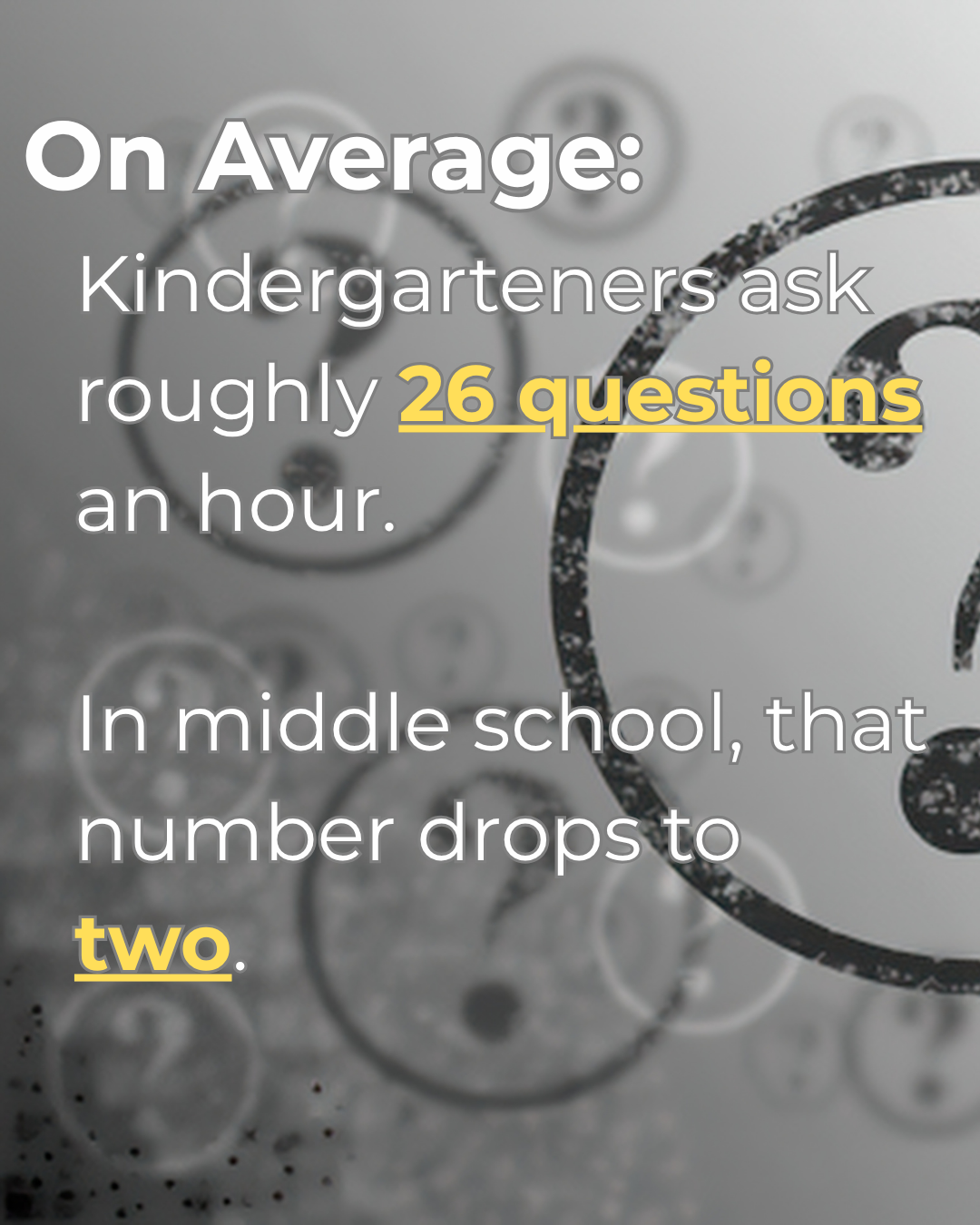
In a study published by Harvard child psychologist Paul Harris, he notes that a child asks about 40,000 questions between the ages of two and five (that’s roughly one question every two minutes). Most of these questions are looking for explanations, and not just facts. However, once children begin schooling, that constant questioning drops off to an average of roughly one question every two hours.
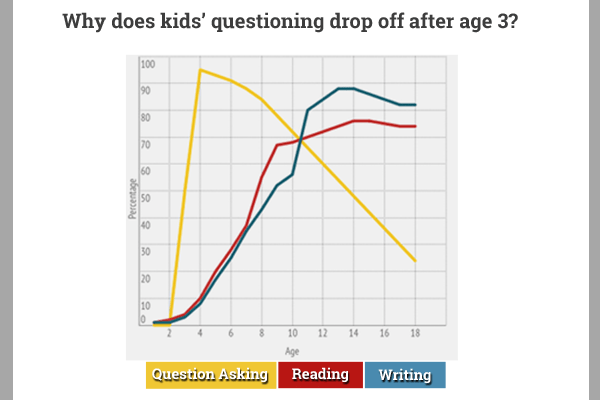
Read that again. Not because it’s shocking in an abstract, gasping-at-a-TED-talk way. Read it again because you have met those kindergarteners. You have also met the middle schoolers. And somewhere between finger paint and fractions, something happened.
Hau’s argument, and this is the part that got me, is that this is not developmental. Kids don’t naturally stop being curious as they get older. We train it out of them. Testing culture, performance pressure, social risk, the subtle-but-constant message that answers are rewarded and questions are a liability. High-achieving students, in particular, were found to be less curious, because curiosity felt dangerous to their GPA.
We did that. Not maliciously. But we did it.
Your Brain Literally Needs to Feel Safe to Wonder
Here’s where the neuroscience comes in, and I promise this is not the boring kind of “brain stuff” you sat through in your undergrad ed psych course.
Curiosity, it turns out, activates the brain’s reward circuitry. Dopamine. The curiosity loop. The whole thing. When students are genuinely curious, they learn faster, remember longer, and connect ideas more richly. It is, neurologically speaking, the optimal state for learning. It’s the aha or lightbulb moments we crave to see in our students.
Harry Caray asked questions for a living and loved every second of it. If there’s one fictional being who out-Carays Caray in the curiosity department…it’s Forky. For the unfamiliar, Forky was a character introduced in Toy Story 4 after being constructed by Bonnie (his maker and the new owner of the titular toys). After dealing with the fear of being alive, Forky received his own series dedicated to him, asking questions.
You might be thinking to yourself, why are you talking about Forky in a section on cognitive science. That’s easy. Forky doesn’t show his true inquisitive side until he feels safe. Safe knowing that he’s now a sentient being. Safe knowing that the other toys that are around him are looking out for his best interests. There is a clear parallel between Forky’s existence and our students.
The prerequisite to Forky asking questions was a feeling of environmental safety. THIS IS HOW THE BRAIN OPERATES! The brain will not open its circuitry to receive dopamine unless it feels safe. When a student feels judged, threatened, or invisible, the amygdala hijacks the whole operation and shuts down the very circuits that make wondering possible. Safety isn’t a feel-good buzzword. It’s a biological prerequisite for learning. Full stop.
Therefore, every time a classroom culture quietly communicates that questions are risky, that not knowing is embarrassing, that the goal is to arrive at the correct answer as fast as possible, the brain literally closes the door on curiosity. Not metaphorically. Literally.
So, How do We Actually Build That?
This is something I’ve become increasingly obsessed with, enough that it’s become a central thread in the book I’m writing about being comfortable “getting weird” in your classroom. One of the overwhelming patterns I keep running into in my research is exactly this: safety is a prerequisite to curiosity. Every time. No exceptions.
And the solution that keeps showing up, the one I fully believe in, is modeling.
Modeling is so important that it’s literally the first thing I tackle in the book I’m writing, and since you’ve read this far, here’s an early look at how that section opens:
1. The “Buy-In” Phase: Lowering the Stakes
Students, especially teenagers, often have a cringe reflex when things get unconventional. To bypass this:
Model the Enthusiasm: If you’re doing an Infomercial Pitch (Activity #27), you must be the first one to use the “As Seen on TV” voice. If you aren’t embarrassed, they won’t be. Remember, you are the first pattern disruptor for your students. The moment a student sees their teacher acting unexpectedly, their brain’s autopilot shuts off before the activity even begins. YOU are the hook!
Acknowledge the Weirdness: Start with, “This is going to feel a bit strange, but we’re doing it because your brain is bored with worksheets.” Honesty builds a bridge. It also does something subtler. It gives students permission to fail publicly. This is the precondition for genuine creative risk-taking. You aren’t just lowering the stakes; you’re redefining what success looks like before anyone picks up a pencil.
Not ready to do a full infomercial voice in front of 28 teenagers? Fair. Start here instead. Stop everything and answer the seemingly off-topic question mid-activity. Pull up a search tab and find out together in real time. Say “I don’t know” out loud, in front of them, without flinching. Let them watch you be curious. Let them watch you not have the answer yet. Because the moment you do that, you aren’t just teaching content anymore, you’re giving them permission.
Permission to not know. Permission to wonder. Permission to be, just a little bit, Whiskers.
Hau offers some complementary practical moves too: Wonder Walls, curiosity pauses embedded in lessons, publicly celebrating questions rather than just answers and a lot of it resonates with the Project Zero thinking routines I’ve been obsessing over lately. (Imagine If, anyone? Feels related. Very related.) But all of it depends on the same foundation: a classroom where students genuinely believe that not-knowing is the starting point, not a failure state.
Hau goes further than the classroom, too; she calls for reduced class sizes, expanded access to high-quality early learning, and evaluation systems that value student questions over quiet compliance. She’s right on all of it. Systemic change matters, and if you’re in a position to advocate for any of those things, you should.
But here’s the reality: most of us aren’t writing policy. We’re writing lesson plans. And the beautiful, slightly uncomfortable truth is that the most powerful lever for restoring curiosity in students isn’t a school board vote or a legislative session.
It’s you. Tomorrow. In your classroom. Before the bell rings.
And Then…There’s AI
Okay. Here’s the part that lives rent-free in my brain on a completely different level.
Hau makes the case that in an AI-driven world, curiosity isn’t a nice-to-have. It’s the whole game. AI can retrieve information. It can summarize, analyze, generate, and explain. What it cannot do, what it is fundamentally incapable of doing, is wonder. It can’t feel the pull of an unanswered question. It can’t decide that a particular mystery is worth years of pursuit. It has no skin in the game of not-knowing.
Here’s what keeps me up at night: we are building tools that can do everything except be curious, while simultaneously building school systems that train the curiosity out of the humans who are supposed to be using them.
In the age of AI, we hear all sorts of phrases thrown around to use it more effectively. From “prompt engineering” to “keeping humans in the loop,” these are the phrases that edu-Twitter has decided will save us (I’m guilty of that, too). However, you cannot engineer a prompt if you’ve never learned how to ask a real question. We cannot effectively keep humans in the loop if that human doesn’t know how to fact-check or push back against something that was AI-generated.
In his new book AI Literacy in Any Class, Matt Miller explores the balance between bots and humanity (Chapter 8). In analyzing a survey from a local school district, Miller writes, “The parents worried that AI would stunt problem-solving skills and diminish critical and creative thinking. I have to admit: as a parent myself, I share these same concerns” (119). While I agree with both Matt and the survey, I think that most parents and decision-makers are misdiagnosing the problem. These cherished problem-solving and critical/creative thinking skills are already diminished.
It feels like the solution schools and parents are craving is to nearly eliminate technological access in schools. In Kansas alone, there is legislation attempting to restrict screen time, and some schools have eliminated their 1-1 device initiatives. This will not do anything to address the root of the problem. Let me say it louder for the people in the back:
BANNING ACCESS TO TECHNOLOGY WILL NOT DO ANYTHING TO RESTORE CRITICAL THINKING SKILLS, TEACH CREATIVITY, OR HELP LEARN PROBLEM-SOLVING SKILLS
Here’s the diagnosis that parents and decision-makers are missing. These desired skills do NOT exist in a vacuum. Problem-solving, critical thinking, and creativity all have a common root. Curiosity. You cannot think critically about something if you were never curious enough to question it in the first place. You cannot solve a problem creatively if wondering ‘what if?’ was trained out of you by the fifth grade.
While I’m not an AI-is-the-solution kind of person, it can very much help close students’ curiosity gaps. AI can do the same thing for our current generation of students in revolutionizing curiosity, just like the Google revolution did for my generation in high school and college. We were able to look and think more deeply because we could now ask questions and receive information that was previously impossible for us to access. We could enrich our understanding of our interests and passions by casting a broader information net. AI has the ability to do the same thing, but better. Google gave us access to answers. AI gives us a thinking partner to help us figure out which questions were worth asking in the first place.
While the reaction of blaming and banning technology might feel like the right prescription, it fails to address the systemic issues that crush curiosity or enable poor pedagogical practice. The real solution is modeling. Again, in Chapter 8 of his book, Miller highlights the importance of modeling AI usage in schools. He makes the case that modeling isn’t just good pedagogy; it’s the mechanism by which healthy AI habits actually transfer from teachers to students to the workplace.
This is a kill-two-birds situation if I’ve ever heard one. If we can model good techniques that inspire curiosity, creativity, and more … can we also model how we use AI tools to explore our own areas in which we are curious?
YES!
The competitive advantage of being human in an AI world is the ability to ask meaningful questions… we need to start treating that ability like it matters. Like it’s something to protect, not accidentally sand down to nothing over the course of twelve years of schooling.
The Most Important Thing You’ll Do Today
AI can write a lesson plan. It can grade an essay. It can generate a rubric, a quiz, a unit overview, and a differentiated reading passage in the time it took you to read this sentence (it can also help check your grammar and sentence fluency in a blog post…Thanks, Claude!).
It cannot wonder.
It cannot feel the pull of a question it doesn’t have the answer to. It cannot sit with a kid who is chewing the end of his pencil and recognize that the silence means something. It cannot decide, on its own, with no prompt, out of sheer human weirdness, that today we are going to stop everything and figure out why the sky is actually blue.
That’s you. That’s the irreplaceable thing.
Your students are curious. It is still in there, behind everything school has asked them to perform, optimize, and suppress. They are still, underneath all of it, little Harry Carays, ready to ask everything, embarrassed by nothing, desperate for someone to take their questions seriously.
Go be that person.
And hey, my friends call me Whiskers.