
If you’ve ever met me in person, you know I’m a strange guy. I’m also authentically strange. The me you see online, in public, presenting at a conference…that’s me baby! My weirdness is probably biological (the woman dyed her hair vibrant colors until the day she died). My academic weirdness stems to a core memory from my senior year of high school (class of ’02 baby).
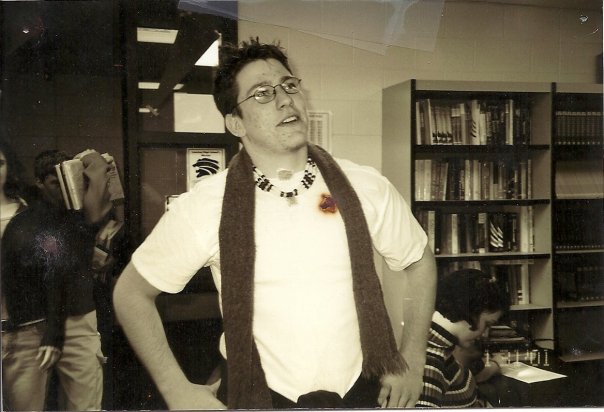
I tried to find one of my senior pictures, and this was the best I could do. Also, 2026 me is jealous of how skinny 2002 me was. Looks like I got some work to do =-(.
But my core memory stems from having to rewrite a paper the day it was due, because my teacher was not happy that I picked a very obscure minor political party (the Light Party) for an essay on parties in my government class. I did the assignment, wrote about everything we were asked to cover, but I guess Icarus flew too close to the sun. I picked the weird thing, not to be different…but because I knew I wouldn’t learn anything from researching the 5 parties who were in play at the time. I’m not making a political statement; I had already done thousands of pages of research on the major and dominant minor parties of the time for debate. I picked the weird thing to compare my knowledge of how parties work to see if any extreme outsider group could have a legitimate chance of electoral success.
What “teacher me” now knows is that I wanted to personalize my assignment to create a connection I found more meaningful. I was seeking agency to differentiate for my needs and interests. What 2002 me knew is that having to rewrite one paper would not stop me from writing about future weird things in academic contexts. Seriously, in college I wrote papers applying Burke’s pentad to the Dead Kennedys song “Kinky Sex Makes the World Go Round,” applying in/out group theory to the Pauly Shore movie Bio-Dome, or even citing the “WuTang Axiom of Finance” in my master’s capstone. What 2002 me did not know yet was that being told to rewrite an essay would profoundly impact the educator I would become when I took control of my own classroom several years later.
Here are three example activities that can help you “get weird,” with some Google Gems that help you generate ideas!
The Secret Cipher
It is painfully obvious that I’m a nerd, especially one who loves puzzles. One who loves WORD and LOGIC puzzles. Ciphers help scratch that itch for me. What makes me love a good cipher is the philosophy of “earned knowledge.” I worked my tail off to decode that message, to crack the cipher, and I am excited to know what it says. So, why can we not embrace that kind of excitement, of “earned knowledge,” when we introduce our topics to our students? The big issue, is that we often crush their curiosity with spoilers.
When we write our topic of the day, our “I can” statement, or give a bellringer question relevant to the lesson, we spoil what we are doing for our students. We give away the ending before the story of our lesson even begins. I like the idea of using a cipher as a lesson hook because we transition the topic of the lesson into knowledge that must be earned. Students will treasure this knowledge because they had to work to unlock it.
Using ciphers targets logic and algorithmic thinking. To solve the cipher, students must perform a series of correct content-based operations. It creates a “feedback loop” where academic accuracy is the literal “key” to moving forward. If the math is wrong, the message remains gibberish; the discipline itself provides the self-correction.
Math: The “shift number” for a Caesar Cipher is the solution to a multi-step algebraic equation.
Science: The cipher key is the Atomic Number of a mystery element identified through clues.
ELA: Encode a “Theme Statement”; students unlock letters by correctly identifying literary devices in example sentences.
Social Sciences: Use a historical code (e.g., the Culper Spy Ring) to encode secret messages about revolutionary troop movements.
Here’s what this activity would look like as a plan:
Mission Title: Operation Steam & Steel
Target: [Mechanization]
Method: Caesar Shift (Key = 4)
Teacher’s Tactical Summary (How to run the game)
The Hook: Tell students a “Luddite Saboteur” has encrypted the secret to the future of industry.
The Tasks: Students solve the 13 history questions to find the Raw Letters (M, E, C, S, J, E, I, B, W, T, A, U, C). Note: These are scrambled or based on specific facts.
The Shift: Tell them the Shift Key is 4.
The Final Unlock: Provide them with the encrypted string: Q I G L E R M D E X M S R.
The Action: They must take your string and move each letter back 4 spaces in the alphabet to reveal the word: MECHANIZATION.
Pro-Tip: If the math gets tricky, remind them that if they hit "A" and need to go back, they "wrap around" to "Z."
Target Letter | The Academic Task (History Question) | Correct Answer | Student’s “Raw Letter” | Encrypted Letter (Shift +4) |
M | The shift from hand tools to M_________? | Machinery | M | Q |
E | Process of fencing off common lands? | Enclosure | E | I |
C | Primary fuel of the Industrial Revolution? | Coal | C | G |
H | The “Flying ______” (John Kay’s invention)? | Shuttle | S | W |
A | The first name of the inventor of the Spinning Jenny? | James | J | N |
N | The country where it all began? | England | E | I |
I | Material used to build bridges and machines? | Iron | I | M |
Z | A name for the new wealthy middle class? | Bourgeoisie | B | F |
A | Who improved the steam engine? (James _____) | Watt | W | A |
T | The first industry to industrialize? | Textiles | T | X |
I | The “Father of the Factory System”? | Arkright | A | E |
O | Movement of people to cities? | Urbanization | U | Y |
N | A system where work was done in homes? | Cottage | C | G |
Interviewing Inanimate Objects
Who says the items around us don’t have thoughts, feelings, or emotions? I’m not saying that I’m going to have conversations with my water bottle when nobody is around (maybe…), but we limit our students’ ability to interact with the abstract until we give things a voice or an attitude. If we give things a voice, it becomes easier for students to conceptualize. This activity is built on the idea of anthropomorphic logic. By giving a soul to a semicolon, a mitochondria, or a mathematical constant, we force students to articulate the purpose and struggle of that object. This strategy posits that if you can explain a concept’s “feelings” (its limitations and strengths), you have mastered its functional utility. It moves the curriculum from “what it is” to “how it feels to be it.”
The joy of this activity is helping shift perspective and create utility analysis. Students must inhibit the ego of the object in this activity. If we interview an equals sign, it needs to explain its obsession with balance. If the Oxford Comma steps into the hot seat, it needs to explain its feelings of neglect and why people might dislike it. This activity requires empathy-driven logic, where the student must defend the behavior of a rule or an object as if it were a personal choice.
Here are quick ideas of how to include something in your content area!
Math: Interview “Zero”—”How do you feel about the fact that no one can divide by you?”
Science: Interview “The Mitochondrion”—”Are you tired of being called a ‘powerhouse’ instead of being understood for your ATP production?”
ELA: Interview “The Oxford Comma”—”Do you feel ignored in a world of casual texting?”
Social Sciences: Interview “The Magna Carta”—”Did you actually think the King would listen to a piece of parchment?”
If you struggle yourself with how to give objects attitudes, or, need an extra jumping off point for some ideas, then I’ve got a gem for you!
The Evidence Bag Challenge
If you really want to get your students talking, give them a bag of objects that seem to have nothing in common, and force them to make a connection! Our brain is encoded to naturally attempt to find meaning in anything. So, when we present students with disparate objects, the brain instinctively attempts to find the thread that binds them. This strategy leverages that drive to move students from rote recall to synthesis. Instead of being given a definition and asked for examples, students are given “clues” (the examples) and must work toward the “category.” It builds cognitive flexibility, as students must constantly adjust their hypotheses as each new, seemingly unrelated item is pulled from the bag.
This activity targets pattern recognition and constraint-based logic. Students must find a single “parent concept” that can house five wildly different “child objects.” This mirrors the scientific method: formulating a theory, testing it against new evidence, and refining it until the “Big Idea” is revealed.
Some examples would include:
Math: Bag: A ruler, a clock, and a “per” sign. (Target: Rate).
Science: Bag: A battery, a wire, and a penny. (Target: Circuits).
ELA: Bag: A mirror, a mask, and a compass. (Target: Character Identity).
Social Sciences: Bag: Salt, gold, and a camel figurine. (Target: Trans-Saharan Trade)
If you struggle with creating lists of random objects, then I’ve got a gem ready for you to play with!