
Some mornings, I walk into my classroom before my students arrive and I tape a sign to the board.
Several years ago, it started on a large Post-it pad, the kind on a wheeled easel — on a morning when I had planning period first, and I knew, before anyone walked through my door, that I was not okay. The sign tells my students what they need to know: where to find their assignments, that loud or unexpected noises are a trigger for me, and that I cannot process more than one person talking to me at a time. It gives them the information they need to still have a productive class. It gives me the space to be present without pretending.
I have an anxiety and panic disorder. Some mornings, the medication takes a while to level things out. Some mornings, it doesn’t level things out at all. On those mornings, I still have a classroom full of students who need me to show up: not perfectly, not effortlessly, but functionally. The bad morning sign is the system I built to make that possible.
I share this not for sympathy. I share it because what I am doing on those mornings has a name. It is managing emotional labor. And every teacher reading this, whether they have a diagnosed anxiety disorder or not, is doing it every single day, in ways they have probably never had language for.
What Emotional Labor Actually Is
The term was coined by sociologist Arlie Hochschild in her 1983 book The Managed Heart, based on her observations of flight attendants. She defined emotional labor as “the management of feeling to create a publicly observable facial and bodily display,” essentially, regulating what you feel and what you show as part of your job description.
Hochschild identified two primary strategies. The first is surface acting: faking an emotion you don’t feel, or suppressing one you do. You smile at the parent who is being unreasonable. You stay calm during the class that is chaos. You perform patience when you are running on empty. The second is deep acting, actually working to shift your internal emotional state to match what the situation requires. You remind yourself why this student is acting out. You find genuine empathy for the kid who is making your life very difficult today.
Research consistently shows that surface acting, the performance without the internal shift, is the one that costs you. A systematic review of 21 studies found strong, consistent associations between surface acting and burnout. Workers who regularly display emotions that conflict with their inner feelings are significantly more likely to experience emotional exhaustion. And teaching, by any measure, is one of the highest emotionally labor-intensive professions that exists.
“Every day, 20 to 25 children arrive at your door, and each is bringing a range of emotions,” one veteran teacher explained in an Edutopia piece on the subject. “You have to be unemotional in order to make space for their emotions.” Hochschild herself, in the same article, described the paradox plainly: “If you’ve had a terrible day at home, you set that aside for the child in front of you, who comes in with his or her own story.”
That is the job. Not just the content delivery. Not just the standards coverage. The job is being the most regulated person in the room, regardless of what is happening inside you, while simultaneously being responsible for the emotional development of every student who walks through your door.
Nobody put that in the job description.
“Remember Your Why” Is Not Enough
Here is what the system offers teachers in response to this reality.
Inspirational posters. Self-care Sundays. And the phrase that has been repeated so often it has become a kind of educational mantra, offered with full sincerity by administrators, consultants, and well-meaning colleagues everywhere:
Remember your why.
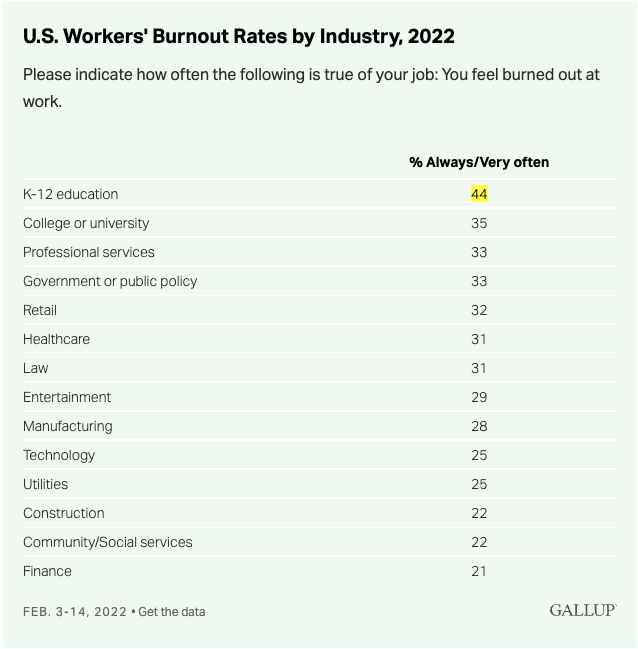
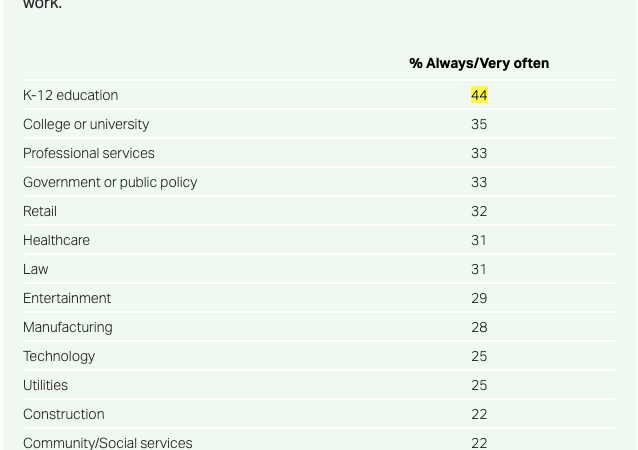
According to a 2022 Gallup poll, 44% of K-12 teachers report feeling burned out always or very often. Not occasionally. Not sometimes. Always or very often. That same poll found that K-12 educators are the most burned out workers of any profession in the United States. Not the most stressed. The most burned out. Of any profession.
The National Education Association found that 78% of educators have considered leaving the profession since the pandemic. The 2025 Teacher Wellbeing Index (a UK study) found that 76% of teachers reported feeling stressed, and 78% experienced symptoms of poor mental health directly related to their work.
And the system’s response is to “remember your why.”
Holly King, in an article through Cognia, put it directly: “Teachers are tired of merely being told to ‘remember their why’ or to engage in self-care. Suggestions like setting better boundaries, saying no to additional tasks, and not taking work home only go so far when expectations from school leaders give a conflicting message.”
Doris Santoro, a professor at Bowdoin College who has spent years studying teacher demoralization, goes further. She argues that “teacher burnout” is actually an inaccurate diagnosis, one that locates the problem inside the teacher rather than in the systems surrounding them. The framing of burnout, she argues, is a “convenient fiction” that asks teachers to learn how to relax rather than demanding that institutions change.
The root cause of educator exhaustion, the NEA’s research concludes, “is a lack of support and respect, not a perceived inability to manage stress.”
Read that again. The problem is NOT that teachers are bad at handling stress. The problem is that they are being handed levels of stress that no amount of mindfulness or morning affirmations was designed to address. And then being told the solution lives inside them.
The Long Game: Compassion Fatigue
There is something that happens when emotional labor compounds over the years. It has a different name from burnout, and it is worth understanding the distinction.
Compassion fatigue is what occurs when the accumulated weight of caring, of showing up emotionally for students, absorbing their trauma, managing their crises, and investing deeply in their outcomes, begins to deplete the very capacity for caring that drew you to teaching in the first place. It is not that you stop caring. It is when caring starts to hurt in a way that feels unsustainable.
Research shows that teachers with a personal history of trauma, exposure to student trauma, and a history of mental illness are all significant predictors of higher compassion fatigue. A three-year longitudinal study of educators in Alberta, Canada, found that mental and emotional health distress was both widespread and intensifying over time, “worsening across gender and job role” with each passing year.
Nearly half of U.S. children have experienced adverse childhood events. With that reality sitting in your classroom every day, how could teachers, in their unavoidably supportive role, not be affected?
I think about this in terms of my own experience. My anxiety disorder does not make me a worse teacher. On the days it is well managed, I think it makes me a more attuned one. More sensitive to the kid in the back row who is performing fine but not okay, more aware of what it feels like to be dysregulated in a room full of expectations. But it also means I carry a higher baseline load into every classroom. The research confirms what I have experienced firsthand: a personal history of mental illness is a risk factor for compassion fatigue. Not a disqualifier from teaching. A risk factor that deserves acknowledgment and support.
Instead, what most of us receive is silence, or worse, the implication that managing our own mental health is a private matter entirely separate from our professional lives.
It is not separate. It never was.
What Actually Helps
I want to be honest here: I am not going to give you a list of self-care tips. Not because self-care is meaningless, but because the research is CLEAR that individual-level interventions cannot solve a structural problem. You cannot bubble bath your way out of a system that does not support you.
What the research actually shows helps:
Peer connection and genuine collegial support, not mandated collaboration, but actual relationships with people who understand what you are carrying. Studies consistently show that social support from colleagues is one of the strongest buffers against exhaustion. The loneliness of teaching is real, and combating it matters.
Autonomy: teachers who have meaningful input into their practice, their curriculum, and their professional decisions report significantly lower burnout. The micromanagement of teachers is not just demoralizing. It is physiologically costly.
Leadership that protects teacher time and wellbeing — not as a program, but as a daily practice. Research on school leaders who explicitly buffer teachers from unnecessary demands, invite their input, and take their mental health seriously shows measurable impacts on retention and satisfaction.
And, I would add honesty. The honesty to name what you are carrying instead of performing wellness you do not have.
My bad morning sign started as a desperate solution on a hard day. Over time, it became something else: a model of self-knowledge, of clear communication, and of trust in my students. I told them the truth about what I needed, and they rose to meet it. They did not need me to be fine. They needed me to be honest and present, and those are different things.
The system will tell you to remember your why. Your why is real, and it matters. But your why cannot be weaponized against your well-being. You are allowed to be a human being who is also a teacher. You are allowed to have hard mornings and panic disorders and days when the medication takes longer than you need it to.
You are not a vending machine. You are a person doing one of the hardest emotional jobs that exists. And you deserve a system that treats you like it knows the difference.

We got this!