
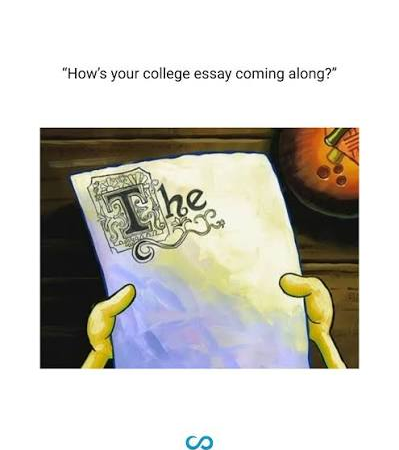
Every year, approximately two million high school seniors sit down to answer one of the most absurd questions in American education.
In 650 words or fewer, tell us who you are, what has shaped you, what you have learned from your greatest challenge, and why you are worth our investment. Please be specific. Please be authentic. Please be compelling. Please do not sound like the other two million people doing this exact same thing.
You have until January.
The college application personal statement is, when you step back and look at it honestly, one of the most sophisticated writing tasks we ask of anyone, teenager or adult. It requires self-knowledge, narrative construction, thematic awareness, and the ability to make a stranger care about your specific, weird, irreplaceable experience in the time it takes them to drink half a cup of coffee. Most adults could not do it well. We ask seventeen-year-olds to do it under deadline pressure while also taking AP exams and applying to fifteen schools simultaneously.
And yet the format itself is genuinely brilliant. Strip away the anxiety and the stakes and the Common App portal that crashes every November, and what you have is a document that demands exactly what the best education always demands: deep self-knowledge expressed through specific, authentic, compelling detail.
Which made me think…
What if the subject doing the applying was not a seventeen-year-old trying to summarize their volunteer hours and their grandmother’s wisdom? What if it was the Louisiana Purchase, making the case for why 828,000 square miles of itself deserves admission to the United States? What if it was Zero, finally applying for recognition from a mathematical community that spent centuries pretending it did not exist? What if it was Gravity, describing the challenge it overcame when Newton sat under a tree and started paying attention for the first time?
Welcome to the College Application Essay activity. Population: every subject, concept, figure, and phenomenon that has ever deserved more credit than it received.
The Cognitive Connection
The college application essay asks its writer to do something that almost no other academic format requires: make a case for significance. Not describe. Not analyze. Not summarize. Make an argument that this particular subject, with this particular history and these particular characteristics, is worth someone else’s investment and attention.
That is a completely different cognitive gear than the five-paragraph essay.
To write a convincing college application essay on behalf of a historical figure, a scientific concept, or a literary character, students have to do three things simultaneously. First, they have to know their subject deeply enough to select the most significant details, which requires judgment, not just recall. Second, they have to construct a narrative arc from those details, which requires synthesis, not just listing. Third, they have to write in a voice that is specific and authentic to their subject, which requires genuine perspective-taking and empathy.
Research on perspective-taking in learning consistently shows that students who inhabit a subject’s point of view demonstrate significantly deeper comprehension and retention than students who describe the same subject from the outside. The college application essay format takes that perspective-taking and adds a layer of advocacy — students are not just inhabiting their subject, they are making the case for why it matters. That combination produces the kind of thinking that a multiple-choice test cannot assess and a traditional essay rarely demands.
There is also something worth highlighting about giving students the ability to choose prompts. The Common App offers five options, and which one a student chooses for their subject is itself a mastery check. A student who selects Prompt 2, recount a time when you faced a challenge, setback, or failure, for the Louisiana Purchase is making an analytical decision about what the most significant and revealing aspect of that subject’s story actually is. A student who selects Prompt 3, reflect on a time when you questioned or challenged a belief, for Zero is demonstrating an understanding of the history of mathematics that goes far beyond definitions and formulas.
The Prompts
Prompt 1
Some subjects have a background, identity, interest, or talent that is so central to who they are that their application would be incomplete without it. if this sounds like you, share your story.
Prompt 2
The lessons we take from obstacles we encounter can be fundamental to our later success. recount a time when you faced a challenge, setback, or failure. how did it affect you, and what did you learn from the experience?
Prompt 3
Reflect on a time when you questioned or challenged a belief or idea. what prompted your thinking? what was the outcome?
Prompt 4
Describe a problem you’ve solved or a problem you’d like to solve. it can be an intellectual challenge, a research query, an ethical dilemma — anything that is of personal importance. explain its significance to you and what steps you took or could be taken to identify a solution.
Prompt 5
Discuss an accomplishment, event, or realization that sparked a period of personal growth and a new understanding of yourself or others.
The Applicants
Let me show you what this looks like in practice across five very different subjects, each one demonstrating a different dimension of what the activity can do.
The Louisiana Purchase, applying for permanent membership in the United States (1803)
The Louisiana Purchase has an interesting application to write. Its most obvious essay angle — “I doubled the size of the country at three cents per acre, you are welcome” — is technically accurate but misses the complexity that makes it genuinely interesting. A student who pushes past that surface answer and writes about the approximately 160 Native nations who were not consulted, compensated, or considered in the transaction has understood something about westward expansion that a timeline of events cannot convey.
The Louisiana Purchase’s best essay is probably Prompt 2, a challenge, setback, or failure, and what it learned. The challenge is not the acquisition. The challenge is holding the full story of how it came to be, and what that story reveals about the gap between how America described itself and what it actually did. A student who can write that essay understands the Early Republic at a level of nuance that is genuinely impressive.
Zero, applying to the number line (circa 9th century CE)
Zero has been waiting a long time for this application.
For most of Western mathematical history, the concept of numerical nothingness was considered philosophically inconvenient — how could nothing be something? The ancient Greeks found the question unanswerable and moved on without acknowledging it. Brahmagupta gave Zero its first formal recognition in 628 CE. Fibonacci carried it to Europe. And slowly, across centuries of resistance, Zero was admitted to the number line.
Zero’s essay is Prompt 3 — a time when you questioned or challenged a belief. The belief it challenged was that nothing cannot be numbered. The outcome was the place value system, algebra, calculus, and the binary code underlying every device your students are currently using to avoid doing their homework. A student who can write Zero’s essay understands the history of mathematics as a human story of resistance, revision, and grudging acceptance rather than a collection of formulas that always existed.
Gravity, applying for recognition from the scientific community (1687)
Gravity has existed since the beginning of the universe and would like someone to acknowledge this.
The challenge with Gravity’s application is that it is genuinely difficult to describe a challenge that Gravity has faced, since Gravity has been relentlessly doing its job since approximately 13.8 billion years ago without anyone’s recognition or assistance. This is, of course, the entire point. Gravity’s essay is Prompt 5, an accomplishment, event, or realization that sparked a period of personal growth and a new understanding of yourself or others. The event is Newton’s apple, or more accurately, the moment someone finally started paying attention. What Gravity learned from that experience is that being fundamental does not guarantee being understood, and that recognition requires not just existence but a witness.
A student who can write Gravity’s essay understands the scientific process — how theories are developed, tested, and formalized, in a way that textbook definitions cannot replicate.
An Unreliable Narrator, applying to graduate school in creative writing
This one is for the ELA teachers.
An unreliable narrator applying to a creative writing MFA program has a genuinely difficult personal statement to write, because everything they say about themselves is, by definition, suspect. Their essay is Prompt 1 — a background, identity, interest, or talent so central to who they are that the application would be incomplete without it. The identity in question is their own unreliability. The challenge is making the admissions committee trust them enough to admit them despite, or because of, the fact that they have told us, repeatedly, not to.
A student who can write this essay understands point of view, narrative reliability, and the relationship between author and reader at a level that most literary analysis prompts never reach. The essay is the argument. The form is the content.
Give it a Shot!
The prompt a student chooses matters. The details they select matter. The voice they find for their subject matters. All of it is content mastery wearing the most distinctive costume in American higher education.
Tag me when your students apply. @justrimmey on X. @teachersplaiground on Instagram.
And if anyone’s subject gets waitlisted, please tell me which one. I have follow-up essay ideas.