A Knowt a day keeps the IDK away.
I will see myself out.
Actually, no. I will not. The research behind that terrible pun is genuinely extraordinary. And we need to remember, really remember, the power of memory and old-school pedagogical techniques to augment our reliance on technology.
On Monday, I wrote about the Fast and Curious EduProtocol and how pairing it with Wayground turns a fifteen-minute daily quiz into one of the most visible growth experiences a student can have in a classroom. If you have not read that post yet, it’s worth the five minutes before you continue here, because this post offers more research behind it.
The Fast and Curious works because it is built on one of the most well-supported findings in cognitive science: retrieval practice. And retrieval practice works because almost everything students naturally do to study is wrong.
Not wrong the way a bad grade is wrong. Wrong the way a compass pointing magnetically south is wrong: confident, consistent, and leading somewhere unhelpful.
What Students Think Works (and Why It Doesn’t)
Ask most students how they study and they will describe some version of the same thing. They reread their notes. They reread the textbook. They highlight things. They watch review videos. They make beautifully color-coded study guides that took three hours to produce and contain almost no active thinking.
When it’s time to review material, students opt for strategies that are the mental equivalent of “push-ups on your knees,” as psychologist Daniel Willingham describes it. Students crave the satisfaction of easy wins, doing lots of repetitions quickly, rather than the harder, more effortful work that actually builds memory.
The problem is not that these strategies feel bad. The problem is that they feel good. Rereading familiar material produces a comfortable sense of recognition — “I know this” — that students mistake for mastery. Most humans tend to assume that re-reading is more effective than retrieval. This makes sense; re-reading requires less effort, and you can’t really make any mistakes. As a result, it just feels superior. However, this absence of effort is exactly what makes it less effective.
The research on this is not subtle. While passive review strategies like rereading lead to rapid forgetting, a single session of retrieval practice can generate memory improvements that persist for 9 months, while the positive effects of retrieval over multiple sessions can last for at least 8 years.
Eight years. From a single repeated practice of pulling information out of memory rather than putting it back in.
What Retrieval Practice Actually Is
Retrieval practice is the act of recalling information from memory without external support: no notes, no textbook, no highlighted paragraph to glance at. The effortful act of reaching for something you learned and pulling it back up is what strengthens the neural pathway that leads to it. The struggle is not a sign that it is not working. The struggle is the mechanism.
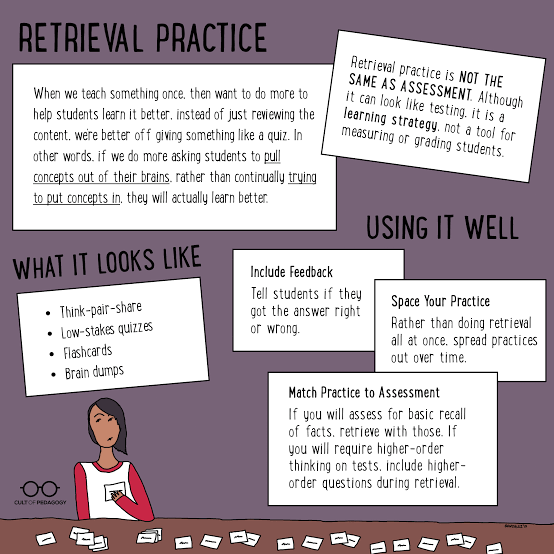
To genuinely commit information to long-term memory, there’s no replacement for active retrieval, that effortful practice of recalling information from memory, unaided by external sources. “Studying this way is mentally difficult,” Willingham acknowledged, “but it’s really, really good for memory.”
The Edutopia retrieval handbook and the Quick and Mighty Retrieval Practices article list fifteen classroom-ready forms this can take: from brain dumps and concept maps to flash cards, low-stakes quizzes, hexagonal thinking, and even Pictionary. The format matters less than the mechanism. As long as students are generating the information from memory rather than recognizing it from a page, retrieval practice is happening.
But Wait — Does Memorization Even Matter Anymore?
Here’s the objection that usually arrives around this point in the conversation.
If students can look anything up in thirty seconds, why does it matter whether it is stored in their heads?

The answer is working memory. When a student’s foundational knowledge isn’t automatic, they have to spend more time and mental energy just to get the information before they can even really begin to work through it. But when a student has memorized key foundational information, they free up their working memory to tackle higher-order thinking.
This is the cognitive science argument that makes retrieval practice more than a classroom efficiency trick. A student who has to look up what the Reconstruction Amendments say every time they appear in a primary source is a student who cannot think carefully about what those amendments meant or why they failed. The lookup cost is not just time. It is cognitive bandwidth, the mental energy that could have been spent on analysis, synthesis, and argument.
Psychology teacher Erin Morris Miller, writing for Edutopia, frames the decision about what to memorize simply: prioritize the most high-utility information for your specific course. Think about the information your students will need consistently throughout the year, as well as the information they will need to know in order to understand the next major topic. You have to know the characteristics of a major literary or historical movement if you are going to understand reactions against it in the next movement; those characteristics would therefore be worthy of committing to memory.
For a history teacher, that means key dates, turning points, constitutional provisions, and the vocabulary of historical thinking: sourcing, corroboration, contextualization, that students will use in every unit rather than just one. When students have a rich store of retrievable knowledge, they have more to be curious about, more material to combine in new ways, and more capacity to make connections to new information in a meaningful way.
Retrieval practice is not about rote memorization for its own sake. It is about building the knowledge base that makes genuine curiosity and deep thinking possible. You cannot wonder about something you have no framework for. You cannot make connections to knowledge you do not have.
The Fast and Curious and Knowt are the mechanisms. Memory is the reason.
The Resistance Problem
Here is where it gets complicated, and where Peps McCrea and memory psychologist William Wadsworth’s work on retrieval buy-in becomes essential reading for any teacher who has tried to implement this and watched students quietly opt back out.
Retrieval practice has the potential to be powerful when it comes to revision. However, despite our efforts to educate students on this approach, it isn’t always embraced wholeheartedly. We must put in place steps to overcome what Wadsworth calls retrieval resistance.
Understanding why retrieval works is not enough to make students do it. A study by Wadsworth and Hibble found that 45% of students still rely predominantly on re-reading or note-taking even after being explicitly taught about the research on retrieval practice.
McCrea and Wadsworth identify three things teachers need to do to get genuine buy-in:
First, convince students that retrieval works specifically for them, not just in general, but for the material they are studying right now. The science helps. Letting students experience the gains themselves helps more.
Second, explicitly message that making mistakes is expected and even desirable. Making mistakes is a good indicator that you’re pushing yourself; just make sure students can correct and re-practice any mistakes as soon as possible.
Third, flag the risk of what McCrea calls unconscious procrastination. When faced with challenging tasks, we can easily find ourselves adopting sophisticated avoidance strategies, such as spending way too much time making the flash cards in the first place or creating beautifully illustrated mind maps. The preparation feels productive. It is not retrieval.
How I Use Knowt to Make This Happen
The Fast and Curious addresses the buy-in problem structurally: students experience their own score climbing across five days and run out of reasons to believe the work is not worth it. But the protocol runs daily on a specific set of questions. What happens the rest of the day? What happens at home?
This is where Knowt earns its place in my Year Zero toolkit.

Knowt generates study materials directly from your own content: notes, readings, lesson slides, PDFs. Students can upload what they have from class, and Knowt produces flash cards, practice quizzes, fill-in-the-blank activities, and matching exercises grounded entirely in that material. Not generic review content. Their actual content.
The flash card feature is particularly well-aligned with the research. Edutopia’s retrieval handbook notes that when studying with flash cards, students often move on from each card too quickly. For long-term memory storage, students should accurately recall the information on a card four or five times before filing it away. Knowt’s spaced repetition algorithm handles exactly this, surfacing cards that students are getting wrong more frequently and retiring cards they have consistently mastered. The pacing is built into the system rather than dependent on student self-regulation.
Knowt also has Kai, an AI study companion that can call students on their devices and conduct an interactive conversation about the material they are studying. That is not a gimmick. That is the protégé effect made accessible outside of class. Research shows that teaching material to a peer is one of the best ways to sort through that material in your own head. If a peer is unavailable, chatbots offer a great alternative; students can tell a chatbot everything they know about a subject and prompt it to ask probing questions that poke holes in their understanding. Kai does exactly that.
Guess what? Knowt is free for students. No subscription, no paywall, no asking a sixteen-year-old to convince a parent to create an account for a homework tool.
The Full Picture
The Fast and Curious gives students the classroom experience of watching their own scores climb through repeated retrieval. Knowt gives them the tools to extend that practice independently. The research gives you the language to explain to students… and to skeptical colleagues, why any of this is worth the effort.
The combination is not complicated. It is just the science of how memory works, made practical enough to fit inside a school year.
Start on Monday. Bring Knowt home with you on Tuesday. Watch those IDK’s melt away.
Cited Research (Hyperlinked throughout)
Edutopia — 15 Quick (and Mighty) Retrieval Practices
https://www.edutopia.org/article/quick-and-mighty-retrieval-practices/
Edutopia — The Essential Retrieval Practice Handbook
https://www.edutopia.org/package/the-essential-retrieval-practice-handbook/
Edutopia — There’s Still a Place for Memorization
https://www.edutopia.org/article/helping-students-memorize-important-information
Evidence Snacks — Retrieval Buy-In (Peps McCrea and William Wadsworth)
https://snacks.pepsmccrea.com/p/retrieval-buy-in
Fast and Curious EduProtocol post (teacher’s plAIground)
Knowt