The first two days of school are a negotiation.
Students are figuring out who you are. You are figuring out who they are. Everyone is performing slightly more than they will for the rest of the year: students performing compliance, teachers performing authority, while the actual relationship that will make learning possible has not yet been established.
I have been teaching for twenty years. I have done the syllabus reading, the procedure walk-through, the icebreaker where everyone shares their name and a fun fact. I have watched students’ eyes glaze over in August with the same quiet patience they bring to every other thing they are required to sit through.
This year is different. This year is Year Zero.
The theme running through everything I am building for my US History and World History classrooms is one I brought home from the Adobe Education Summit in San Jose: your story matters. Not as a slogan. As a design principle. Every activity in my first two days is built around that idea; giving students the chance to tell their story, to interrogate how stories get told, and to begin thinking about why any of it matters.
Here is what those two days look like. I’ve created, remixed, or borrowed 7 activities for students to complete in their own order and at their own pace. It is a mixture of breaking the ice, establishing norms, building culture, and sneaking in some content while crucially setting the tone for the semester. These activities are both set up as stations that students can move through, OR they can complete the paper activities on Google Classroom on their own, if they wish. The only thing that is truly fixed across these first two days is the bell schedule.
The Vessel: Their History Passport
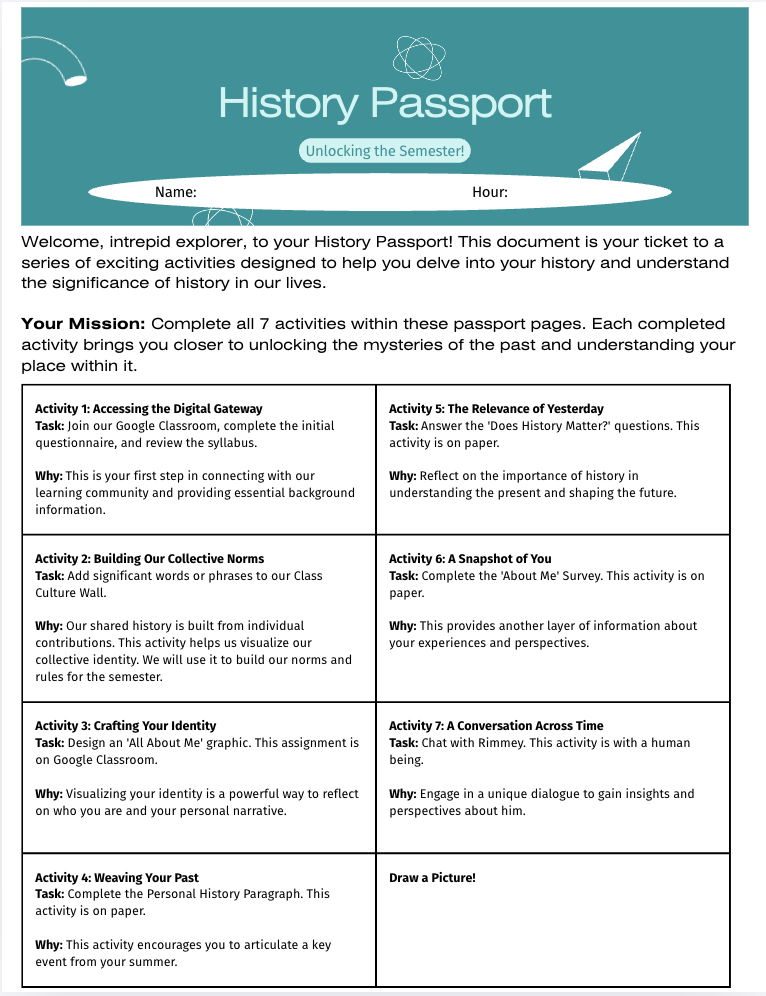
To give students some structure for their activities, I’ve created their “history passport” in Canva. This document does two things: it lists the expectations for the 7 activities, but more importantly, it explains why. I am going to attempt to “remember the why” (ugh) when giving students assignments all semester. I think this is one trick to working with Gen Alpha students: if they do not see value in an activity or understand why you, as a teacher, see value in it, they may not complete the task, because they either don’t care or see it as a waste of their time.
This might not be just an accommodation for Gen Alpha alone. Self-Determination Theory, the psychological framework developed by Deci and Ryan that underlies some of the most robust research on human motivation, argues that autonomous motivation requires understanding purpose. Students who know why they are doing something engage more deeply, persist longer, and retain more than students who are simply complying with an instruction. The why is not a courtesy. It is the mechanism by which compliance becomes genuine engagement.
There is also a practical argument that has nothing to do with pedagogical research. If you cannot explain why an activity is worth a student’s time, that is useful information. It either means the activity needs a better rationale or it needs to be replaced. Writing the why into the passport is as much a quality check on my own instructional design as it is a communication tool for students. Every time I had to articulate the purpose of one of these seven activities, I was also asking myself whether I actually believed it. The activities that survived that question are the ones on this list.
Activity 1: Student Interest Survey OR About Me Grid (Student’s Choice)
The first choice students make in this classroom is a real one.
Two options are available from the moment they walk in: the We Are Teachers Student Interest Survey: a comic-panel formatted questionnaire that asks everything from preferred name to what one thing a teacher should know about them to what their biggest misconception about high school students is or the About Me Grid, a more personal document covering family situation, hobbies, career goals, favorite things, and five words to describe yourself.
Students choose one. Not because the teacher assigned one. Because they get to decide which format feels right for them.
That choice is the first signal about what kind of classroom this is going to be.
Both documents are linked below and free to use.
📎 Student Interest Survey (We Are Teachers)
📎 About Me Grid (Adapted from a free Laura-Randazzo Activity)
Activity 2: A Big Moment
Before students think about history, they think about their own.
A Big Moment is a five-minute personal narrative prompt, adapted from the OER’s World History Project: take a memorable moment from your summer: the most fun you had on a single day, a cool trip, a dope meal, your best score on a video game, an important turning point, and write about it with as many details as you can. If you are stuck, write about your first day of school so far today.
The prompt is deliberately low-stakes and wide open. The point is not the product. The point is that the first piece of writing a student does in this classroom is about something that actually happened to them, in their actual life, that they actually care about. Before we ask them to analyze a primary source or evaluate a historical argument, we ask them to be witnesses to their own experience.
That is not a soft warmup. That is the argument the whole year is built on.
📎 A Big Moment (adapted from OER Project, CC BY 4.0)
Activity 3: What Is History? Does It Matter?
Here is where the content begins more directly, but quietly, without announcing itself.
The Unit 1 Notebook opener presents four statements students evaluate with yes, no, and an explanation:
Studying history isn’t relevant to my life.
There is only one story of our past.
An event looks the same in history no matter your perspective.
Memory doesn’t play a role in the study of the past.
Students record their initial responses. They will revisit those responses at the end of the unit and see how their thinking has evolved.
This is prior knowledge activation wearing a very convincing costume. It does not feel like a pre-assessment. It feels like an argument waiting to happen. And for students who just spent five minutes writing about their own memorable moment, the question of whether memory plays a role in the study of the past lands very differently than it would on day one of a traditional syllabus review.
📎 What Is History? Does It Matter? (adapted from OER Project, CC BY 4.0)
Activity 4: Log In to Google Classroom
Unglamorous. Essential.
Google Classroom is how students access the Adobe Express activities below. Getting logged in during the first two days means no time is lost later. A brief how-to is posted in Classroom for students who need it.
Activity 5: A Conversation With Me
This one has no handout.
Somewhere across the first two days, every student has a conversation with me. Not a formal check-in. Not a structured interview. Just a conversation. I learn their name, they learn something about me, they ask whatever they want to ask.
It is the most important activity on this list.
Every other activity gives me information about students. This one gives students information about me. And the relationship that makes a classroom work cannot be entirely one-directional. Your story matters is not just a prompt I give students. It is a commitment I make to them.
Activity 6: All About Me Graphic (Adobe Express)
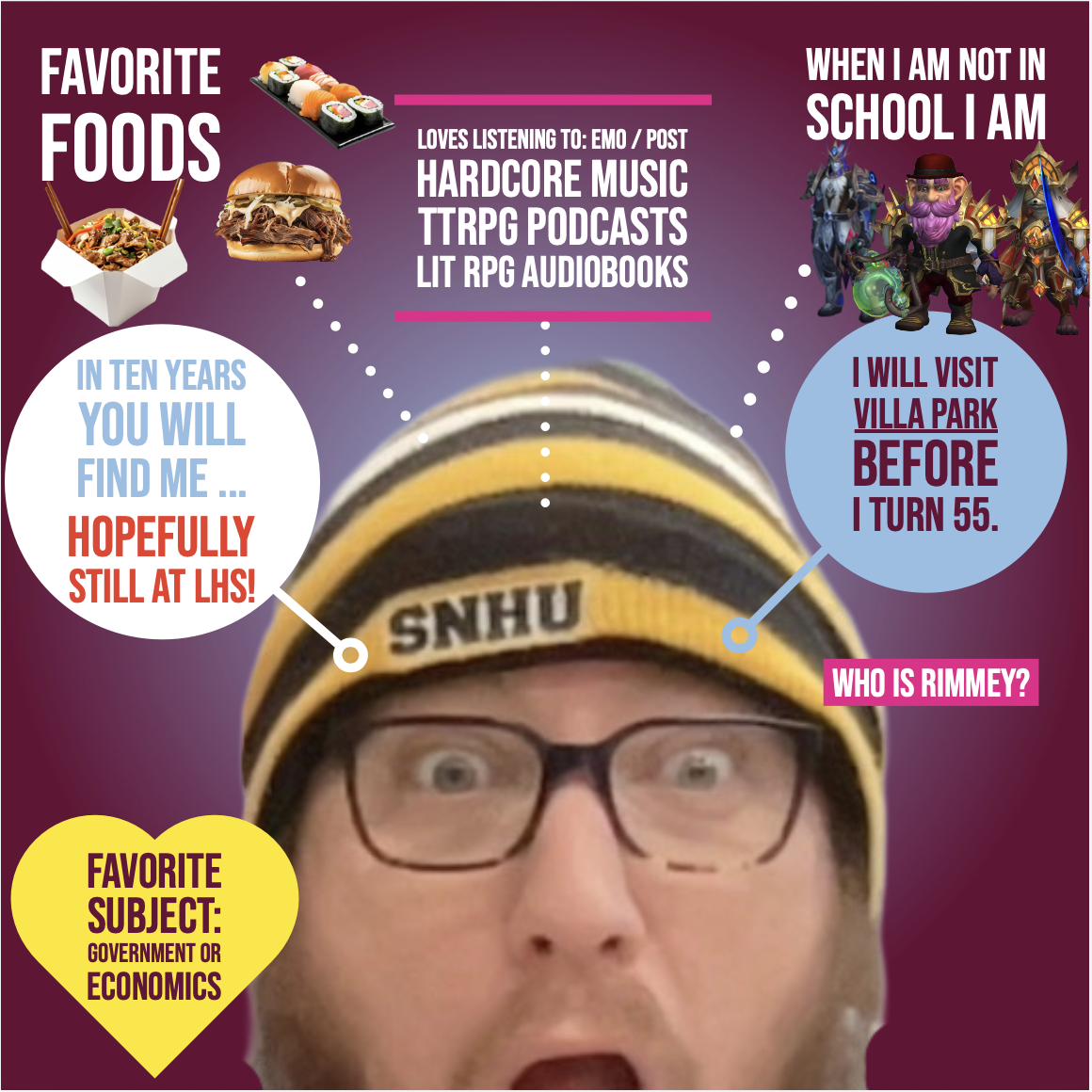
Students use Adobe Express to create a visual representation of themselves — an All About Me graphic that captures who they are in a design they can customize however they wish.
This is the creative expression version of the About Me Grid. Same information, completely different cognitive demand. Choosing what to include, how to arrange it, what colors and fonts and images represent them; that is design thinking applied to self-knowledge. And the results, when students bring genuine creative investment, are the kind of first-week work that belongs on a wall rather than in a gradebook.
Template linked below — free Adobe Express account required, available to all students.
📎 All About Me Graphic
Activity 7: Class Culture Poster (Adobe Express)
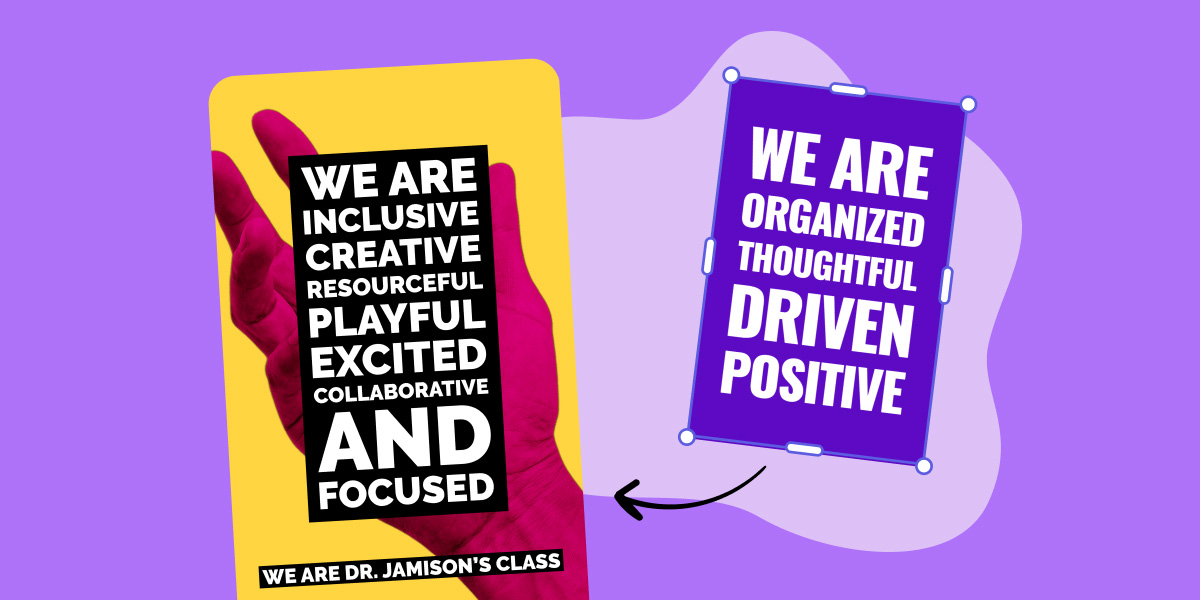
The final activity flips the lens from individual to collective.
Students use a Padlet wall on a standalone computer (in case not everyone has their device yet) to contribute to a class culture poster. These posters will serve as a visual document of who we are as a group, what we value, and what kind of classroom we are building together. It is the “your story matters” argument made communal. Every individual story that students told across the first two days becomes one piece of a
larger story that belongs to all of us.
Once everyone has their device, groups will take important words/phrases from the padlet wall and design a poster in Adobe Express!
📎 Class Culture Poster (Adobe Express)
The Underlying Approach
None of these activities are about classroom management. None of them are about procedures. None of them are about making sure students know where to find the bathroom pass.
They are about establishing, from the first moment students walk in, what kind of learning is going to happen here. Learning that starts with the student. Learning that treats their experience as evidence. Learning that asks them to think, create, and tell the truth about who they are before it asks them to analyze anyone else.
Your story matters. Seven activities. Two days. One idea that is going to carry us all year.